Japan Launches Historic Phobos Sample-Return Mission
Japan launches the MMX spacecraft on a five-year mission to study Phobos and return the first samples from the Mars system.
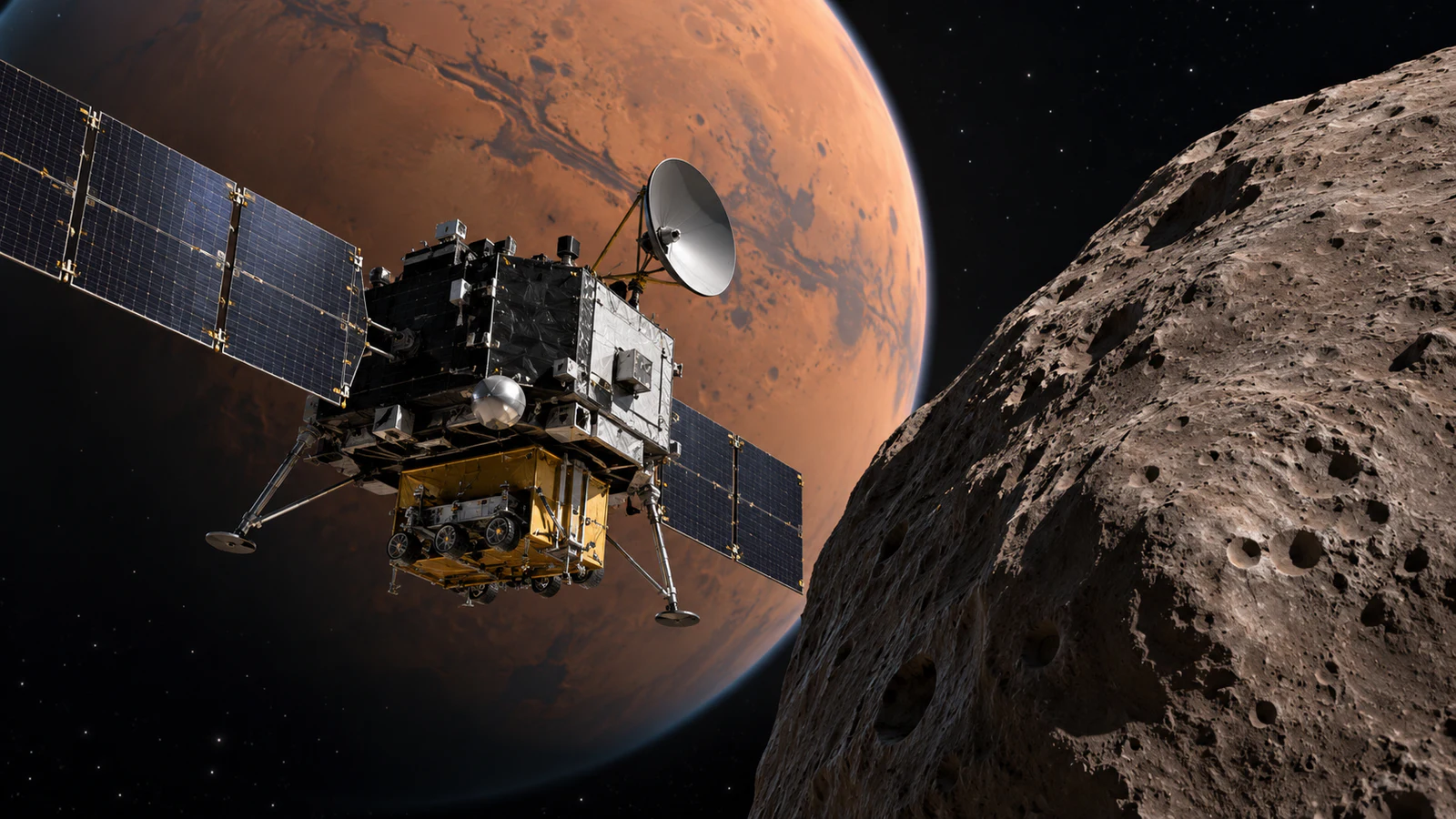
Image credit: AI-generated editorial illustration by OpenAI
Japan has successfully launched its Martian Moons eXploration spacecraft on a five-year journey to Phobos, beginning an ambitious mission designed to return the first samples ever collected from the Mars system.
The Japan Aerospace Exploration Agency, known as JAXA, launched MMX aboard an H3 rocket from the Tanegashima Space Center at 4:41:03 a.m. Japan Standard Time on October 20. JAXA said the rocket flew as planned and separated the spacecraft about one hour and 11 minutes after liftoff, placing it into its intended trajectory.
MMX is expected to reach Mars in August 2027 before beginning detailed observations of Phobos, the larger of the planet's two small moons. If the mission proceeds as planned, the spacecraft will make two soft landings, collect at least 10 grams of surface material and deliver the sample capsule to Earth in 2031.
No mission has previously returned material from the Martian system. That makes MMX a major test of both planetary science and the engineering needed for a round trip spanning hundreds of millions of kilometres.
Why Phobos matters
Phobos and the smaller moon Deimos have puzzled scientists for decades. Both are dark, irregularly shaped bodies that resemble some asteroids, but their exact origin remains uncertain.
One leading possibility is that the moons are asteroids captured by Mars. Another is that they formed from debris thrown into orbit after a major object struck the planet early in its history. Laboratory analysis of material from Phobos could help distinguish between those scenarios.
JAXA's mission overview says the samples and remote observations will be used to study how the Mars system formed and how water and organic material moved through the early Solar System. MMX will map Phobos, examine its internal structure and composition, measure its gravity and observe Deimos during the later part of the mission.
The scientific value extends beyond identifying where the moons came from. If Phobos formed from a giant impact, some of its material may preserve evidence from ancient Mars. If it is a captured asteroid, it could offer a record of primitive material transported from another region of the Solar System.
A rover will scout the surface
Before the main spacecraft attempts its sampling landings, it will deploy a compact German-French rover named Idefix. The 25-kilogram vehicle was developed jointly by the German Aerospace Center, DLR, and the French space agency, CNES.
DLR said after the successful launch that Idefix is scheduled to reach the surface around the turn of 2028 and 2029 and operate for about 100 days. Its instruments and cameras will study the texture, composition, temperature and mechanical properties of the surface while helping mission teams prepare for the spacecraft's landing.
Phobos presents unusual engineering conditions. Its gravity is only a tiny fraction of Earth's, so a rover cannot simply drive as it would on Mars or the Moon. Idefix has a specially designed running gear and an uprighting system to control its movement after release.
The European Space Agency says the rover would weigh the equivalent of only about 15 grams on Phobos despite having a mass of 25 kilograms. That extremely weak gravity also complicates sampling because tools must collect material without pushing the spacecraft away from the surface.
Two landings and a long return
After arriving in the Mars system, MMX will enter a quasi-satellite orbit that allows it to remain close to Phobos while still orbiting Mars. It will use cameras, spectrometers and other instruments to select suitable landing sites.
JAXA plans two soft-landing operations to gather regolith, the loose rock and dust covering the moon. The spacecraft carries different sampling systems to improve the chance of obtaining useful material from the unfamiliar surface.
The European Space Agency's mission timeline says MMX is due to conduct its main sampling work in 2030. It will then leave the Mars system and fly back toward Earth. The return capsule is expected to land in Australia in 2031 before being transferred to Japan, where the material will be catalogued and shared with international research teams.
Scientists will be able to examine the returned grains with instruments that are far too large or sensitive to send into space. They can also preserve part of the sample for future researchers using techniques that have not yet been invented, following the approach taken with material returned from asteroids Ryugu and Bennu.
An international mission led by Japan
Although JAXA leads MMX, the project includes contributions from NASA, ESA, CNES and DLR. The spacecraft carries a broad suite of scientific instruments, including cameras, spectrometers, a laser altimeter, a radiation monitor and the two sampling devices.
JAXA identifies Yasuhiro Kawakatsu as the MMX project manager. The mission is the agency's largest international collaboration in lunar and planetary exploration and builds on Japan's experience with the Hayabusa asteroid sample-return programme.
The launch had originally been planned for 2024 but was postponed as Japan reviewed the schedule after the first H3 rocket failed in 2023. The successful flight of H3 Flight No. 10 and the confirmed separation of MMX therefore represent important milestones for both the mission and Japan's new launch system.
Years of cruise, orbital operations, landings and the return journey still lie ahead. For now, the successful departure from Tanegashima has turned MMX from a development programme into an active interplanetary mission, carrying the prospect that a small quantity of Phobos dust could answer one of the enduring questions about Mars and its moons.
Source links
Comments
No approved comments yet.