NASA Awards 2026 Innovative Technology Concepts
NASA's Innovative Advanced Concepts program has announced 18 Phase I awards totaling $3.2 million, funding early-stage research into technology concepts ranging from hovering robots for lunar lava tube exploration to a…
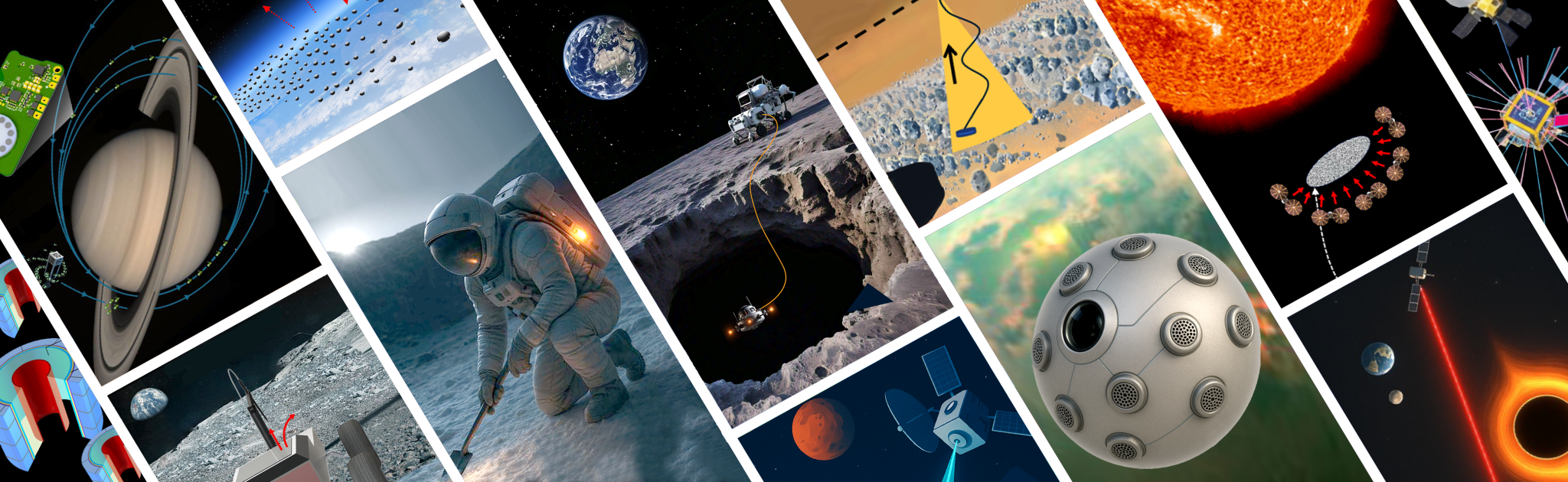
NASA's Innovative Advanced Concepts program has announced 18 Phase I awards totaling $3.2 million, funding early-stage research into technology concepts ranging from hovering robots for lunar lava tube exploration to a swarm of 10,000 small satellites designed to map Saturn's rings.
How the program works
Each of the 18 awards is capped at a maximum of $175,000 and funds an initial nine-month investigation period, giving researchers a relatively small but meaningful runway to develop early feasibility studies for concepts that are, by design, meant to be genuinely speculative and far from ready for actual mission use. NIAC's Phase I structure exists specifically to fund ideas too early-stage and unproven for NASA's mainstream mission-development pipeline, but promising enough to warrant a focused feasibility study.
The lunar exploration concepts
Among the funded projects are hovering robots specifically designed to explore lunar lava tubes, the underground volcanic tunnels on the Moon that have drawn increasing scientific interest as potential sites for future habitats due to the natural radiation and temperature protection they could offer. Related awards fund temperature management systems for mobile robots operating in these extreme lunar environments, and radioisotope-heated suits intended to help astronauts survive the Moon's brutal temperature swings during extended surface operations.
Looking outward to Venus and Saturn
Other awards target very different parts of the solar system. One project focuses on hardening scientific instruments to survive Venus's extreme surface conditions, among the most hostile environments for spacecraft anywhere in the solar system. Perhaps the most conceptually striking award funds a proposal to map Saturn's rings using a swarm of 10,000 small satellites working in coordination, alongside a related concept for ring sample collection systems that could eventually retrieve physical material from the rings for study.
Concepts that reach beyond our solar system entirely
Several awards push even further, funding early feasibility work on interstellar spacecraft propulsion concepts, exoplanet continent-mapping techniques, methods for observing the photon ring around black holes, and gravitational wave detection approaches, research areas that sit at the genuine frontier of what spacecraft technology and astrophysical observation might achieve decades from now rather than in the near term.
The philosophy behind funding ideas this early
NIAC program director Greg Stover framed the underlying rationale for funding such speculative, far-future concepts directly: "Achieving that will require more than incremental technological advancement. It means we need great leaps." That statement captures the program's core purpose, rather than only funding safe, incremental improvements to existing spacecraft technology, NIAC deliberately backs ideas that might fail entirely but could also represent the kind of genuine leap that incremental research alone would never produce.
What happens after Phase I
Most NIAC-funded concepts don't advance directly into actual missions, the nine-month Phase I investigation is explicitly meant to test basic feasibility, with only a subset of ideas progressing to more developed Phase II or Phase III funding stages, and an even smaller fraction eventually informing real mission designs years or decades later. Even so, the program's track record of funding ideas that initially sounded implausible, some of which later fed into real NASA mission concepts, gives this year's slate of hovering lunar robots, ring-mapping satellite swarms and interstellar propulsion studies a reasonable, if long, shot at eventually shaping how NASA explores both the solar system and deep space beyond it.
Comments
No approved comments yet.