Faisal Kundi Chairs First KP Advisory Council Meeting With Security as Top Priority
Governor Faisal Karim Kundi chairs the first KP Advisory Council meeting, prioritising security, counterterrorism capacity and public services.
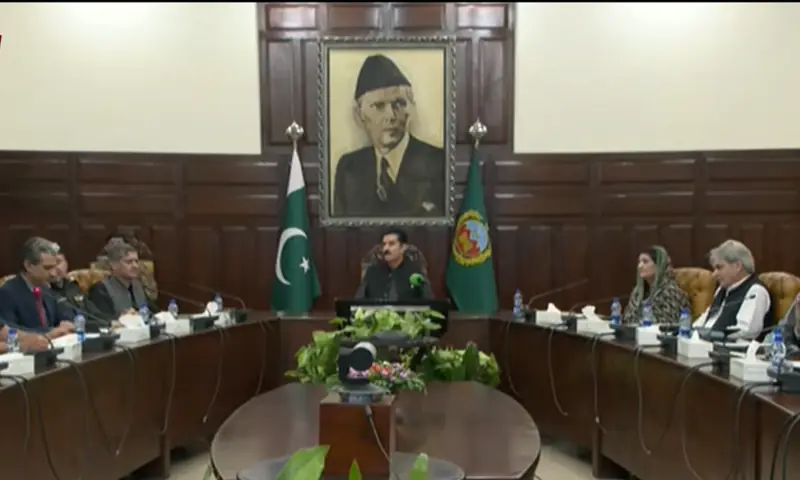
Image credit: DawnNewsTV via Dawn
**PESHAWAR:** Khyber Pakhtunkhwa Governor Faisal Karim Kundi has chaired the first meeting of the province's new 11-member Advisory Council, placing security, counterterrorism capacity, public services and anti-corruption measures at the centre of the administration's programme following the imposition of emergency and governor's rule.
The council was formed by the federal government after President Asif Ali Zardari approved emergency measures under Articles 232 and 234 of the Constitution. Its members have been assigned portfolios and will assist the governor in running provincial affairs.
At the opening meeting, members introduced themselves and their areas of responsibility. Kundi said they would receive departmental briefings and have a short period to familiarise themselves with their assignments before being expected to deliver measurable results.
Security and counterterrorism lead agenda
Kundi identified the restoration of law and order and the protection of residents as the administration's first priorities. He said the province had paid a heavy price for terrorism and that the state must target not only armed groups but also the financing, recruitment, illegal weapons and extremist networks that support them.
According to Radio Pakistan, the governor pledged greater resources, training, technology and intelligence support for the police and Counter Terrorism Department. He also promised support for the families of police personnel killed in the line of duty.
Kundi said the National Action Plan and other counterterrorism measures would be implemented without targeting any particular ethnic group, language, region or political affiliation. He stressed that Pakhtuns were victims of terrorism rather than its cause.
The governor also called for stronger coordination among the police, armed forces and other law-enforcement agencies. He argued that improved security was necessary to attract investment, revive tourism and allow residents to use schools, hospitals and markets without fear.
Council assigned provincial portfolios
The federal government has assigned the Home Department to Kifayatullah Khan, finance to Tariq Mahmood Pasha, law to Amir Javed, education to Dr Syed Amir Abdullah and health to retired Lieutenant General Nigar Johar Khan.
Other members include Dr Sarfaraz Ali Shah for mines and minerals, Dr Muhammad Irshad for industries and commerce, Asif Rafiq Afridi for communication and works, Maulana Muhammad Tayyab Qureshi for religious affairs and Osman Saifullah Khan for energy. Samar Haroon Bilour has been assigned information.
Kundi said the council must work quickly and show a clear difference through its performance. He announced zero tolerance for corruption and directed members to ensure that decisions were followed through within established deadlines.
The governor also encouraged the council to study effective initiatives in Punjab, Sindh and Balochistan and adopt approaches that could improve governance in KP, regardless of where they originated.
Services, investment and tourism
Beyond security, the meeting addressed healthcare, education, employment, roads, electricity, water and municipal services. Kundi said government performance should be judged by practical improvements for citizens rather than statements alone.
He highlighted the province's oil, gas, mineral, hydropower and tourism potential, arguing that peace could help change KP's image and attract investors and visitors. Conflict-affected districts would receive particular attention for public services and development projects.
The council's first meeting therefore set out a broad agenda that combines counterterrorism with administrative reform and economic development. Delivering all three will require coordination between the governor's office, provincial bureaucracy, federal institutions and security agencies.
Emergency remains politically contested
The meeting took place against strong political opposition to the emergency. The PTI has rejected governor's rule as unconstitutional and undemocratic and has said it will challenge the decision in courts, legislatures and public forums.
PTI leaders argue that security cannot be improved by weakening provincial autonomy or setting aside the electorate's mandate. The federal government says the measures were necessary because of deteriorating security and what it describes as the previous provincial government's failure to cooperate fully with counterterrorism policy.
Dawn reported that Kundi told residents the extraordinary steps were not intended to target a particular political party or group. He said the purpose was to restore peace and asked the public to cooperate.
The constitutional proclamations must now move through the required parliamentary process. Article 234 provides that governor's rule must be approved by a joint sitting within the prescribed period if it is to continue.
The Advisory Council's credibility will depend on whether it can improve security and public services while operating within those constitutional limits. Its first meeting established priorities; implementation and political legitimacy will be the harder tests.
Source links
Comments
No approved comments yet.
Related Articles
 Ishaq Dar Condemns Riyadh Airport Attack as Six Pakistanis Are Injured
 KP Governor Warns of Legal Action Against Attempts to Disrupt Public Order
 Reported KP Emergency Framework Includes District Development Council and Advisory Body
 British Council Marks a Decade of Library Services in Karachi and Lahore