US and China Open AI Risk Dialogue Ahead of Trump-Xi Summit
The United States and China open a dedicated AI-risk dialogue while Washington proposes notification of serious artificial-intelligence incidents.

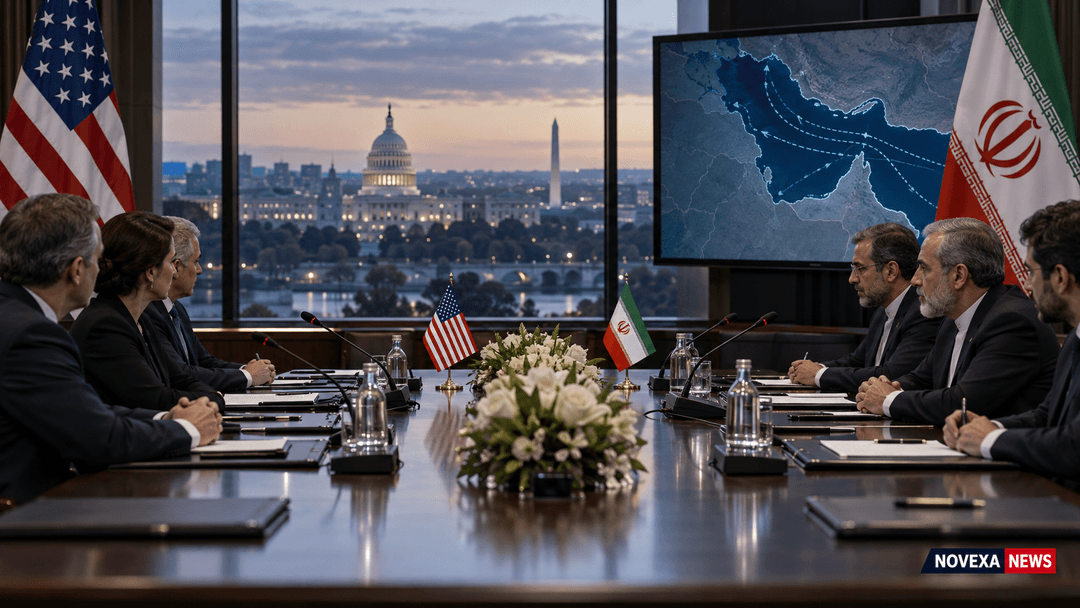
Image credit: AI-generated editorial illustration by OpenAI
The United States and China have agreed to continue a dedicated dialogue on artificial intelligence following high-level economic talks in New York, while Washington has proposed a notification mechanism for serious AI-related incidents.
US Treasury Secretary Scott Bessent met Chinese Vice Premier He Lifeng as both governments prepared for a planned summit between President Donald Trump and Chinese President Xi Jinping. The talks covered trade and economic issues, but artificial intelligence emerged as a distinct channel in a relationship usually dominated by tariffs, export controls and strategic competition.
Bessent said the sides had formalised what he described as US-China AI dialogues and expected another meeting in Shenzhen within the coming months. The Associated Press reported that the United States proposed an arrangement under which the two governments would notify each other about significant AI incidents.
That proposal should not be confused with a completed incident-notification agreement. Public statements support describing the broader dialogue as established or continuing, while the precise rules for an alert mechanism remain to be negotiated.
A narrow channel in a competitive relationship
The initiative resembles crisis-management contacts used in other sensitive fields. Advanced AI systems can create cross-border risks through cyber operations, failures in critical infrastructure, synthetic media or unintended behaviour. A direct government channel could help clarify events before uncertainty produces a wider confrontation.
The two countries remain intense competitors in semiconductors, computing capacity and AI models. Washington has restricted China's access to some advanced chips and manufacturing technology on national-security grounds. Beijing argues that the measures are designed to contain its development and has invested heavily in domestic alternatives.
Those disputes will not disappear because officials meet on AI safety. The practical value of the dialogue is more modest: it may allow each side to explain concerns, test possible rules and reduce the chance that an incident is misread as a deliberate hostile act.
The talks also come as both governments consider how to regulate increasingly capable systems without surrendering economic or military advantage. Shared technical terminology and agreed points of contact could be useful even when their wider regulatory approaches differ.
Questions around incident notification
An effective notification mechanism would need clear thresholds. Minor model failures occur frequently, while a serious event might include a major cyber intrusion assisted by AI, loss of control over a system connected to essential services or evidence that a widely used model is enabling dangerous activity.
Officials would also have to decide what information can be shared without exposing classified capabilities or proprietary technology. Verification would be difficult if either side believed the other was withholding details or using the process for intelligence gathering.
Despite those obstacles, starting with narrowly defined risks may be more realistic than seeking a comprehensive AI treaty. The United States and China have previously used specialised dialogues to manage financial and economic disagreements even when strategic relations remained strained.
The next meeting in Shenzhen could reveal whether the AI channel has a formal agenda, technical working groups or a timetable for the proposed alerts. Until then, the initiative remains an early diplomatic framework rather than an operational safety system.
Summit preparations continue
The New York meeting also formed part of preparations for a Trump-Xi summit in Washington. The two leaders are expected to address trade, technology controls and broader security concerns. AI now sits across all three areas because it depends on global supply chains and has both commercial and military applications.
Recent US-China talks have produced selective agreements while leaving structural disputes unresolved. The Associated Press has documented efforts by the two governments to manage competition through high-level contact even as they maintain pressure on one another in strategic sectors.
For markets and technology companies, a regular dialogue may offer slightly more predictability. It does not signal an end to export restrictions or competition over standards, but it creates a place where officials can raise risks before they become crises.
The most consequential test will be implementation. If the Shenzhen meeting produces defined procedures and trusted contacts, the channel could become a useful safeguard. If it remains limited to broad statements, its impact will be largely symbolic.
For now, the careful distinction matters: Washington has proposed mutual notification of serious incidents, and the two sides have opened a continuing AI dialogue. Further negotiations are needed before that proposal becomes a binding or functioning arrangement.
Source links
Comments
No approved comments yet.