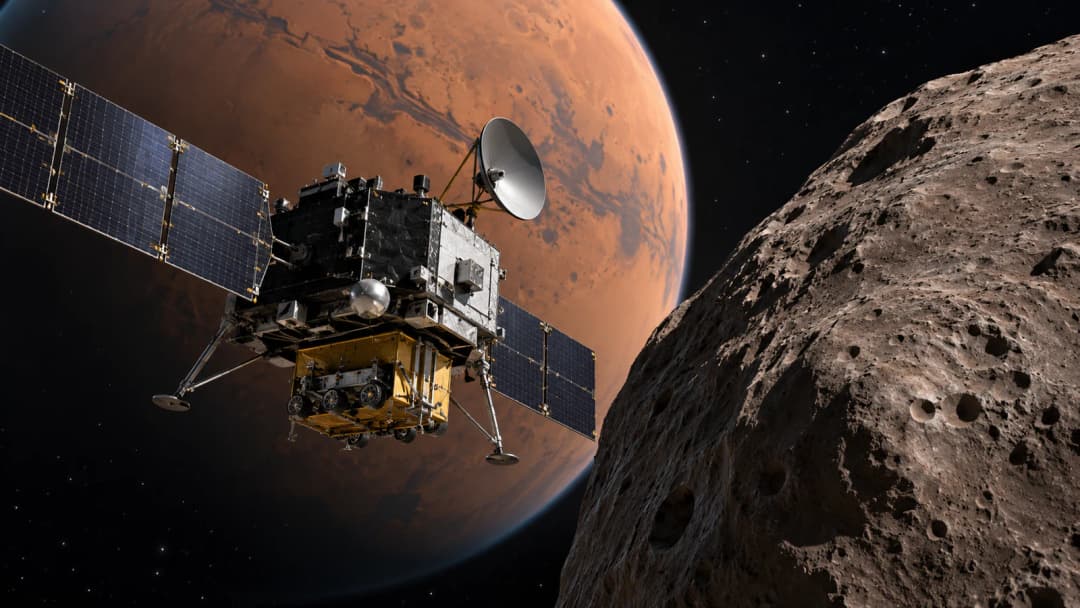
Mars Crescents Sharpen in NASA Psyche Flyby Sequence
NASA’s Psyche mission has produced a detailed look at Mars during a 2026 flyby, capturing the planet as a growing crescent in the days leading up to close approach. The new composite brings together images taken between…

NASA’s Psyche mission has produced a detailed look at Mars during a 2026 flyby, capturing the planet as a growing crescent in the days leading up to close approach. The new composite brings together images taken between May 2 and May 15, 2026, showing how Mars changed in appearance as the spacecraft moved nearer for a gravity assist.
The growing crescent of Mars as NASA’s Psyche mission approa ches
The sequence begins with Mars appearing as a very small crescent at the center of the composite, when the planet was still farthest from the spacecraft. As Psyche continued its approach, the illuminated portion of Mars steadily expanded. By the time of close approach, the planet was large enough that it began to overfill the field of view.
NASA says the images were taken with the spacecraft’s multispectral imager instrument. The views were collected before close approach, when Mars appeared as a thin crescent because Psyche was arriving from a high phase angle, meaning the spacecraft was seeing the planet lit only partly by reflected sunlight. That geometry produced the narrow crescent visible in the days before the encounter.
The flyby was more than a visual milestone. It also gave the mission team a way to document the full encounter with Mars, from approach through close pass and departure. According to NASA’s Photojournal description, the separate views were later combined into a time-lapse that captures the sequence of the spacecraft’s passage by the planet.
Why the Mars imagery matters
Images like these are valuable because they show how a spacecraft’s viewing geometry changes as it moves through planetary space. In this case, the sequence reveals the transition from distant approach to close encounter in a way that is both scientifically useful and visually clear. The narrowing crescent, the gradual widening of the illuminated surface, and the eventual close-up views together provide a compact record of the flyby.
The composite also helps illustrate the role of Mars in the Psyche mission’s trajectory. NASA identifies the encounter as a gravity assist, a maneuver used to alter or support a spacecraft’s path by using a planet’s movement and gravity. While the supplied source does not add broader mission details, it does show that Mars served as an important waypoint in Psyche’s route.
For mission observers, the sequence offers a rare look at how a spacecraft experiences a planetary pass. The image progression shows not just a changing shape, but a change in perspective: from a tiny crescent at long range to a planet that fills more and more of the instrument’s field of view as the spacecraft closes in.
A composite built from multiple stages
NASA says the final product draws from approach, close approach, and departure views of Mars. That makes the image set more than a single snapshot. It is a compiled record of a full encounter, built from observations captured over nearly two weeks in May 2026.
The result is a visually striking reminder of how planetary flybys are recorded by spacecraft instruments. In Psyche’s case, the Mars sequence documents not only where the spacecraft was going, but how the scene changed from one phase of the encounter to the next.
The image is credited to NASA, JPL-Caltech, and ASU, and it was added to NASA’s Photojournal on July 17, 2026.
Comments
No approved comments yet.