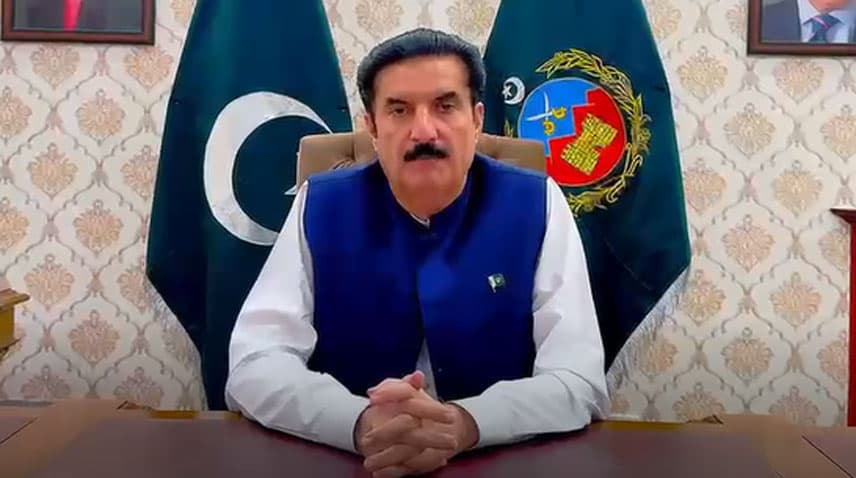
Lt Gen Aamer Raza Promoted to 4-Star Rank, Appointed First Commander National Strategic Command
Lieutenant General Aamer Raza, currently serving as Chief of General Staff, has been promoted to the four-star rank of General and appointed as the first Commander of Pakistan's newly created National Strategic Command…
Lieutenant General Aamer Raza, currently serving as Chief of General Staff, has been promoted to the four-star rank of General and appointed as the first Commander of Pakistan's newly created National Strategic Command, a position that now holds nuclear management responsibilities previously assigned to a role that has been abolished entirely.
What the appointment actually is
The Prime Minister's Office announced the promotion on July 24, with Prime Minister Shehbaz Sharif personally congratulating the newly promoted general and wishing him well for what officials described as "this important responsibility." The National Strategic Command, or CNSC, position is entirely new, created under Pakistan's 27th Constitutional Amendment, passed in 2025, which restructured the country's military command architecture in a meaningful way.
The role it replaced
Critically, the CNSC's nuclear management responsibilities were previously held by the Chairman of the Joint Chiefs of Staff Committee, a position that has now been abolished as part of the same restructuring that created Raza's new role. Rather than simply adding a new command layer on top of the existing structure, the reform consolidated and relocated a highly sensitive area of national responsibility, nuclear command and control, into a newly defined position built specifically for that purpose.
How the appointment process works
The appointment is made based solely on the recommendation of the Chief of Defence Forces, currently Field Marshal Asim Munir, and notably cannot be challenged in court, a structural feature that places this specific appointment process outside the reach of judicial review entirely. That insulation from legal challenge reflects the extraordinarily sensitive nature of the position, nuclear command responsibilities are not typically subject to the kind of appointment disputes that might arise over other senior civil or even most military postings.
Raza's background and prior recognition
Before this promotion, Raza served as Chief of General Staff, one of the Pakistan Army's senior staff positions, and has previously been recognized with two of Pakistan's notable military honors: the Hilal-i-Imtiaz (Military) and the Sitara-i-Basalat. That combination of senior staff experience and prior decoration positions him as an established, senior figure within the military hierarchy rather than an unexpected or junior appointment to a role of this sensitivity.
Why this restructuring matters beyond one appointment
Nuclear command and control arrangements are among the most closely watched aspects of Pakistan's military and security architecture, both domestically and among international observers tracking regional nuclear stability. Formally relocating that responsibility from an abolished joint chiefs position into a newly created, dedicated command, with an appointment process that sits outside judicial challenge, represents a structural change to how Pakistan organizes one of its most sensitive national security functions, not merely a personnel announcement about who holds a particular title.
What comes next
With Raza now formally installed as the first person to hold this newly created position, how the National Strategic Command actually operates in practice, its relationship to the Chief of Defence Forces, its coordination with other military commands, and its overall role in Pakistan's broader security architecture, will likely become clearer only as the command matures under his leadership, since this restructuring has no direct precedent within Pakistan's own military command history to compare it against.
The timing of the announcement, coming directly from the Prime Minister's Office rather than through a routine military press release, also underscores how much political as well as institutional weight has been placed on getting this particular transition right, given the sensitivity of the responsibilities now consolidated under Raza's new command.
Comments
No approved comments yet.