Islamabad Entry Routes Restricted as Security Tightens Ahead of Protests
Islamabad and Rawalpindi tighten security and restrict key approaches as JI, PTI and farmers prepare separate protest marches toward the capital.
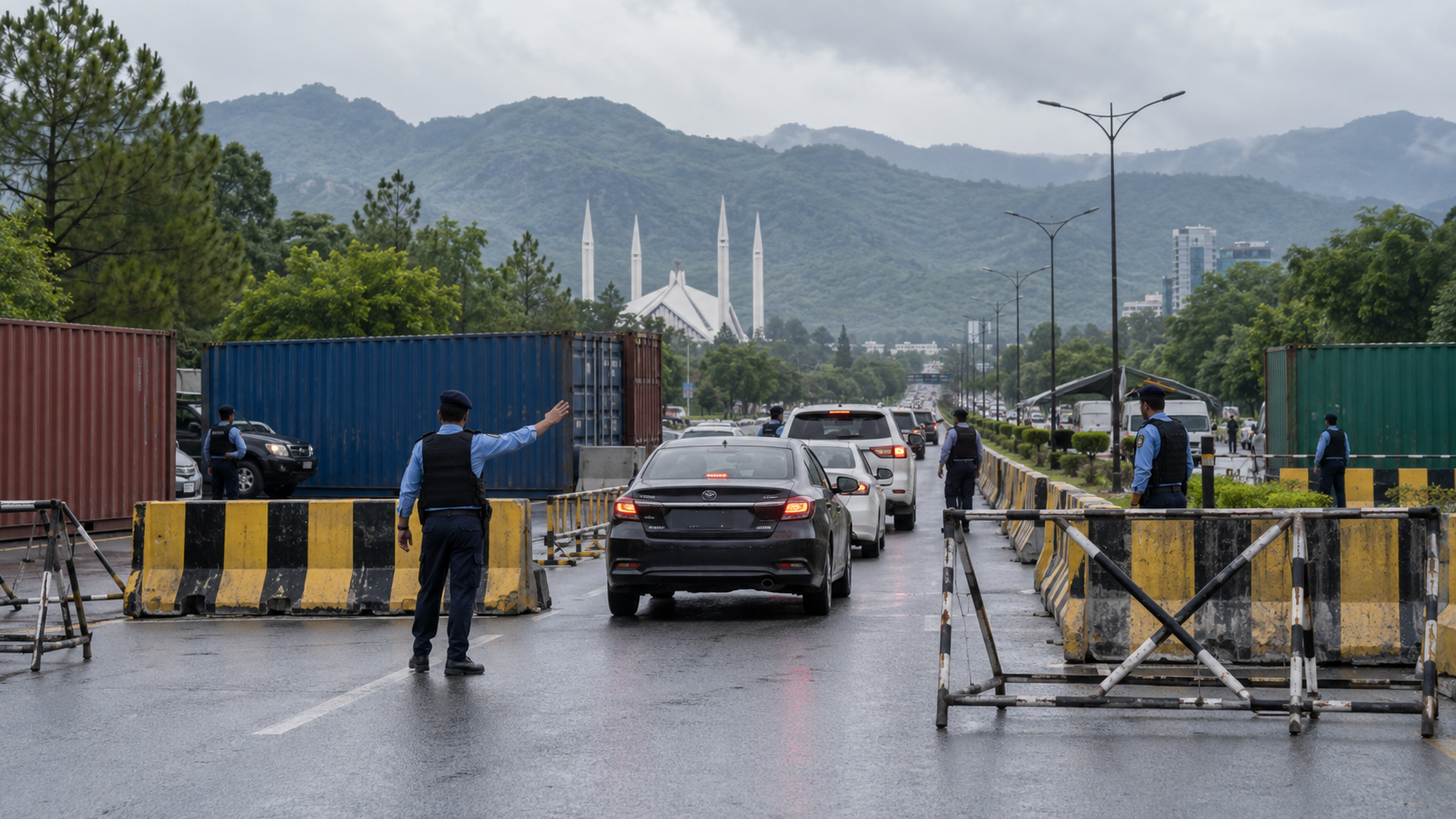
Image credit: AI-generated editorial illustration by OpenAI
Authorities have intensified security preparations across Islamabad and Rawalpindi ahead of several planned political marches, placing containers and barriers at major routes while preparing a large deployment intended to prevent demonstrators from occupying central areas of the capital.
D-Chowk has been sealed, and barriers have been positioned near T-Chowk Rawat, Serena Chowk, Srinagar Highway, Margalla Avenue and Faizabad, according to local reporting. Officials have also surveyed approaches from Khyber Pakhtunkhwa as they prepare for protest caravans expected during the week.
More than 22,000 security personnel are expected to be deployed in Islamabad, while additional forces have been requested for Rawalpindi and Attock. Dawn reported that authorities planned to restrict as many as 30 entry points across the twin cities, including 11 in Rawalpindi.
The scale of the operation reflects several overlapping protest calls. Jamaat-i-Islami has begun a march against the petroleum levy, Pakistan Tehreek-e-Insaf has announced a September 27 demonstration seeking the release of its founder Imran Khan, and Kissan Ittehad has also planned a march over farmers' demands.
Barriers on approaches from KP
Authorities have considered additional obstacles on routes linking Khyber Pakhtunkhwa with the capital. Locations named in local reports include G.T. Road, Chungi No. 26, Pir Wadhai, I.J. Principal Road, Aswal Mor and Katti Pahari.
ARY News reported that the administration was examining trenches and other restrictions on some approaches. The precise condition of individual roads can change quickly, and travellers should rely on Islamabad Traffic Police and motorway updates rather than assuming every listed route is fully closed.
Containers placed beside roads can be moved rapidly when officials decide to close an access point. That flexibility is useful for security planning but creates uncertainty for commuters, freight operators and people travelling to the airport or hospitals.
The administration says it must protect government buildings, maintain order and stop groups from blocking public roads. Officials have also referred to an Islamabad High Court judgment emphasising the public's right to movement and setting limits on the occupation of roads and use of government resources for political activity.
Political parties defend right to assemble
PTI and JI maintain that peaceful political assembly is a constitutional right. They argue that mass preventive restrictions can disrupt the city before protesters arrive and can make confrontation more likely by denying agreed routes.
Interior Minister Mohsin Naqvi has urged PTI to reconsider its September 27 march and warned organisers that they could be held responsible for violence or loss of life. Novexa previously reported the minister's warning and the legal dispute surrounding the planned demonstration.
JI's Khyber Pakhtunkhwa procession has meanwhile departed from the Bab-i-Khyber area, while a rail-based caravan has travelled from Karachi. The party says its campaign seeks withdrawal of the petroleum levy and broader relief from fuel-related costs.
The farmers' mobilisation adds another set of demands and organisers to an already complex security picture. Managing several groups arriving on different routes requires clear communication about gathering points, permitted movement and dispersal times.
Cost to residents and businesses
Business associations and transport operators have warned that prolonged closures could damage commercial activity in both cities. Retail deliveries, intercity buses and goods transport are especially vulnerable when major junctions are blocked without long notice.
Transporters have also complained about the seizure or requisitioning of containers and heavy vehicles for security barriers. A container held for several days can interrupt supply chains and impose costs on owners even if no protest reaches the location where it is placed.
Residents face a different burden: longer journeys, uncertainty about school and office schedules, and concern about access to medical facilities. Authorities can reduce those effects by publishing timely route maps, keeping emergency corridors open and avoiding restrictions that extend beyond assessed security needs.
The coming days will test whether the administration and protest organisers can maintain communication. Agreed routes and visible crowd management could preserve both public safety and the right to assemble. Conflicting instructions or sudden closures would increase the risk of congestion and confrontation.
For now, security preparations remain preventive. D-Chowk and several approaches have been restricted, but the status of other roads is likely to change as marches move closer to Islamabad. Travellers should confirm conditions shortly before departure and allow additional time.
Source links
Comments
No approved comments yet.