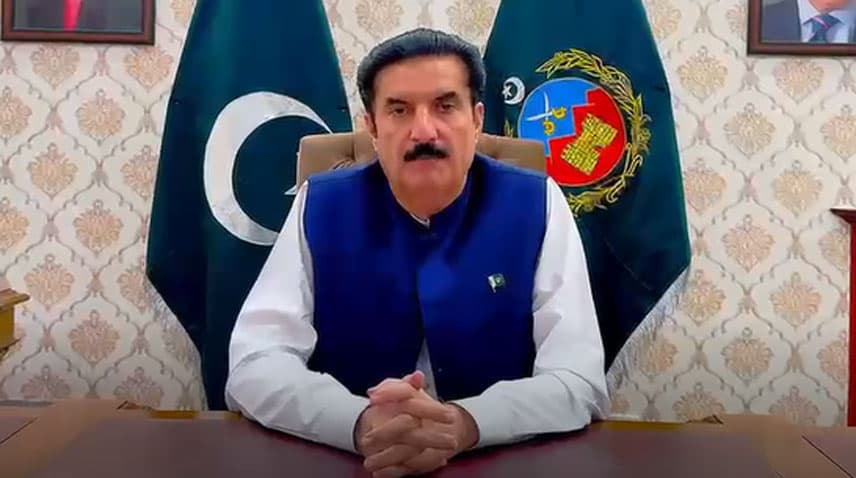
DPM Dar Meets Kyrgyz President, China's Foreign Minister on Sidelines of SCO Moot
Pakistan's Deputy Prime Minister and Foreign Minister Ishaq Dar used the sidelines of a Shanghai Cooperation Organisation foreign ministers' meeting to hold a string of bilateral talks, while placing the bulk of his…
Pakistan's Deputy Prime Minister and Foreign Minister Ishaq Dar used the sidelines of a Shanghai Cooperation Organisation foreign ministers' meeting to hold a string of bilateral talks, while placing the bulk of his public remarks on a familiar and pointed message: that terrorism emanating from Afghan soil remains the central obstacle to regional stability.
Dar's central argument
Addressing the SCO Council of Foreign Ministers, Dar stated plainly that "durable peace, stability and economic development can only be achieved with the eradication of the menace of terrorism emanating from Afghan soil." He went further than a general statement, citing specific figures: Pakistan has lost more than 560 citizens in over 2,000 terrorist attacks so far this year, and he alleged that the groups responsible operate "under the watch and facilitation of the Afghan Taliban regime," a direct and pointed accusation against Kabul's ruling authorities rather than a vaguer reference to regional instability.
A packed schedule of bilateral meetings
Beyond his formal remarks to the full council, Dar held separate bilateral meetings with Kyrgyz President Sadyr Nurgozhoevich Zhaparov, Iranian Foreign Minister Abbas Araghchi, and Chinese Foreign Minister Wang Yi, a sequence of meetings that reflects Pakistan's effort to use the multilateral SCO gathering as a venue for advancing several bilateral relationships simultaneously rather than treating the summit purely as a forum for collective statements.
The SCO's structure and Pakistan's upcoming role
The Shanghai Cooperation Organisation comprises ten member states, India, Iran, China, Pakistan, Russia, Kyrgyzstan, Belarus, Kazakhstan, Tajikistan and Uzbekistan, with Afghanistan and Mongolia holding observer status. Notably, Pakistan is set to assume the SCO chairmanship for 2026-27, a position that will give Islamabad a formal platform to push its Afghanistan-focused security concerns to the top of the organization's agenda over the coming year, well beyond what a single foreign minister's speech can accomplish.
A diplomatic credential Dar chose to highlight
Dar also used the platform to remind fellow SCO members of Pakistan's broader diplomatic role in the region, specifically its hosting of US-Iran talks in April that produced the Islamabad Memorandum of Understanding in June. He described that MoU as representing the first high-level direct contact between the United States and Iran in 47 years, a framing intended to position Pakistan not just as a country managing its own security crisis but as a credible regional mediator capable of brokering breakthroughs between larger, more powerful adversaries.
Why raising Afghanistan at the SCO matters strategically
The SCO includes China, which maintains its own significant economic and security interests in Afghanistan, and Iran, which shares a long border and complex relationship with the Taliban government. Raising Pakistan's Afghanistan-terrorism grievance directly in front of both of these powers, rather than only through bilateral channels, is a deliberate attempt to internationalize a dispute Islamabad has often struggled to elevate beyond its own bilateral tensions with Kabul.
What comes next
With Pakistan's SCO chairmanship beginning shortly, Dar's remarks at this meeting function as something of a preview of how aggressively Islamabad intends to use its upcoming leadership role to press the Afghanistan-terrorism issue onto the broader multilateral agenda, a strategy that will only prove successful if it translates into coordinated pressure from SCO members on Kabul rather than remaining, as it has largely been so far, primarily a matter of Pakistani statements at international forums.
Comments
No approved comments yet.