Gohar Urges Consensus Before Creating New Provinces
PTI Chairman Barrister Gohar Ali Khan says any new provinces must follow constitutional procedure and secure public and political consent.

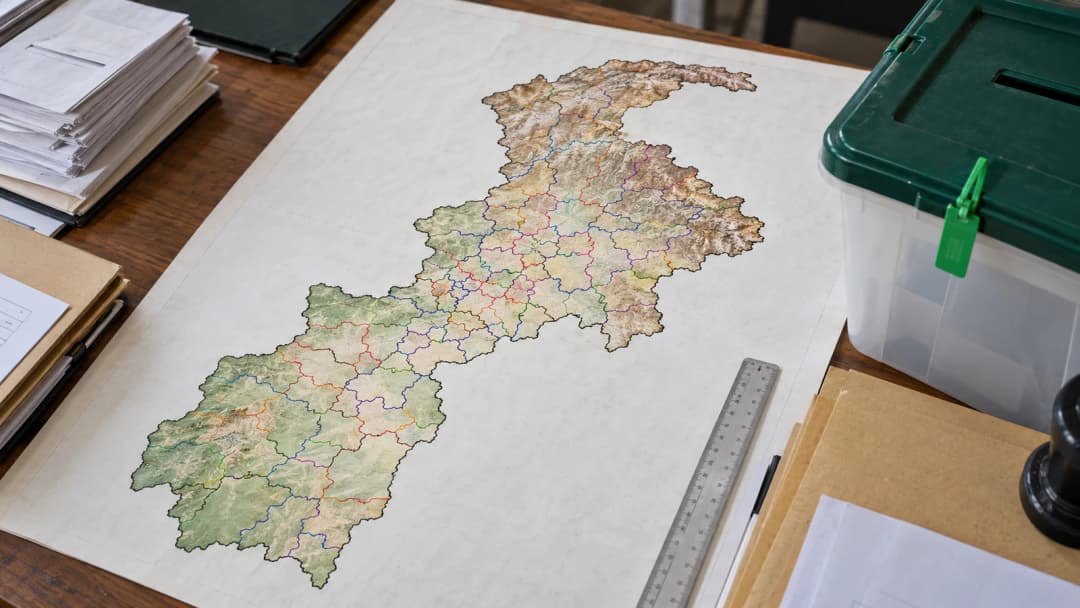
Image credit: AI-generated editorial illustration for Novexa News
Pakistan Tehreek-e-Insaf Chairman Barrister Gohar Ali Khan has warned against rushing decisions on new provinces, saying any change to Pakistan's federal structure must rest on constitutional procedure, political consensus and public consent.
Speaking to journalists in Islamabad on September 7, 2026, Gohar said dividing an existing province against the wishes of its residents and elected representatives could weaken the federation. He called for consultation before legislation or boundary changes are attempted.
His intervention adds PTI's position to a widening debate involving federal ministers, coalition parties and provincial leaders. The argument is no longer simply about whether smaller administrative units might improve services; it now concerns who has the authority to propose them and how public approval would be established.
Gohar calls for a commission and parliamentary debate
Gohar proposed first building broad agreement, then establishing a commission to examine the issue. He said elected representatives should deliberate on any resulting proposal rather than allowing a major constitutional change to emerge from political statements alone.
He compared the required process with the extensive negotiations that preceded the 18th Constitutional Amendment in 2010. That amendment changed important aspects of the relationship between the federation and provinces and was adopted after cross-party consultation.
The comparison does not prescribe a particular map or number of provinces. It instead underscores the scale of agreement Gohar believes would be necessary before altering the structure of the federation.
Constitutional requirements create a high threshold
Creating a new province is not an ordinary administrative decision. Article 239 of Pakistan's Constitution requires a constitutional amendment, including a two-thirds majority in Parliament. When a change alters a province's limits, the affected provincial assembly must also approve it by a two-thirds majority.
Those requirements make political consensus a practical necessity as well as a democratic objective. No single minister, party or federal cabinet can redraw provincial boundaries through an announcement.
A commission could examine boundaries, finances, resource distribution, representation in the National Assembly and Senate, administrative capacity and the location of provincial institutions. Its work would still need to move through the constitutional process.
Debate grows over governance and population
Interior Minister Mohsin Naqvi has argued that Pakistan will eventually need additional administrative units because its population and demand for public services have outgrown parts of the existing system. He has also said the decision should be constitutional and left to the people.
Planning Minister Ahsan Iqbal has framed the policy choice as either empowering local governments across Pakistan's districts or developing a consensus for a larger number of provinces. Other political figures have supported devolution without committing to new provincial boundaries.
These positions overlap on the need for better service delivery but differ on institutional design. Smaller provinces might bring some decisions closer to residents, while stronger elected local governments could pursue decentralisation without redrawing provincial borders.
Sindh remains the most sensitive question
The Pakistan Peoples Party has strongly resisted proposals that could divide Sindh. The Sindh Assembly has passed a resolution rejecting the creation of new provinces within the province, while PPP leaders have stressed Sindh's political identity and territorial integrity.
MQM-P has renewed calls for a separate province or new administrative arrangement centred on Karachi. Those competing positions show why a reform presented as technical can quickly become a dispute over identity, representation and resources.
Gohar's warning focused on consent from the people and representatives of any affected province. A credible consultation would therefore need to explain what problem a new unit is intended to solve, how boundaries would be selected and how revenues and constitutional representation would change.
What a consensus process would need to address
Any serious proposal must compare new provinces with alternatives such as empowered local governments, better provincial finance arrangements and stronger district administration. It should also publish evidence on costs, service delivery and population rather than relying only on slogans.
Pakistan's debate is likely to continue, but Gohar's position sets a clear political condition: reform should strengthen the federation and cannot be imposed without constitutional approval and the participation of affected communities.
Does PTI oppose all new provinces?
Gohar's remarks focused on opposing a rushed or unilateral process. He called for consensus and institutional review before a final decision.
Can Parliament create a province on its own?
A constitutional amendment requires two-thirds support in Parliament, and a boundary change also requires two-thirds approval from the affected provincial assembly.
What would a commission examine?
It could study boundaries, finances, representation, governance capacity and public consent before presenting recommendations.
Source links
Comments
No approved comments yet.
Related Articles
 ECP Records Clarify KP National Assembly Constituency Boundaries
 KP Governor Warns of Legal Action Against Attempts to Disrupt Public Order
 Reported KP Emergency Framework Includes District Development Council and Advisory Body
 KP CM Afridi Calls for Governor Impeachment Law, Rejects Further Operations