Space update: Captured multispectral imager instrument NASA’s Psyche mission, this
NASA’s Psyche mission has returned a detailed look at Mars from a recent flyby, producing an enhanced-color mosaic that highlights the planet’s rugged southern highlands in unusual texture and contrast. The view was…
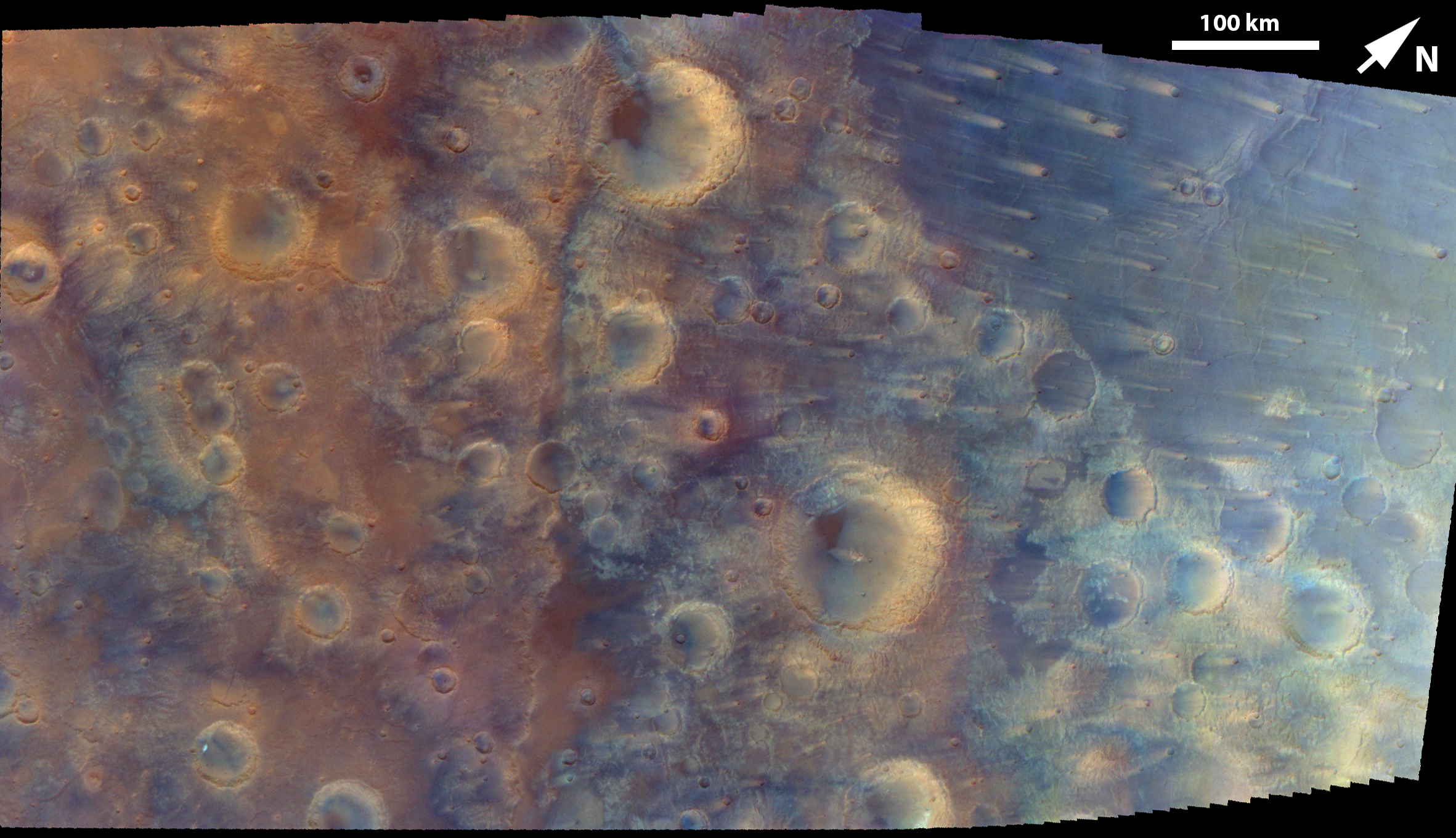
NASA’s Psyche mission has returned a detailed look at Mars from a recent flyby, producing an enhanced-color mosaic that highlights the planet’s rugged southern highlands in unusual texture and contrast. The view was assembled from four images taken by the spacecraft’s multispectral imager on May 15, 2026, offering a close look at surface features as Psyche passed the planet.
The image set was captured over about six minutes while the spacecraft moved from right to left, or from northeast to southwest across Mars. According to NASA Breaking News, the resulting mosaic uses near-infrared, green and blue filters, a combination that helps bring out differences in surface materials. In this case, the enhanced-color processing reveals craters, ridges, wind streaks and volcanic plains materials across part of the Martian landscape.
What NASA Psyche mission images show
The mosaic focuses on a section of the Iapygia region, an area in Mars’s southern highlands known for rough terrain. The covered span runs from about 62 degrees east to 78 degrees east longitude and from 4 degrees north to 14 degrees south latitude. That makes the image more than a simple postcard view: it is a mapped observation that places visible features within a specific part of the planet.
One of the most prominent landmarks in the frame is the crater Fournier, located just below the center of the mosaic. NASA says it measures about 71 miles, or 114 kilometers, across. Another notable feature is a long, irregular cliff system called Oenotria Scopuli, visible as a linear element just left of center and running from the top to the bottom of the mosaic. This scarp system is tied to the broader circular structure of the Isidis impact basin, which lies to the northeast of the area shown.
The source material also notes that the image resolution varies across the mosaic, from 381 meters per pixel on the right side to 440 meters per pixel on the left. That difference reflects the geometry of the flyby and the changing distance or viewing conditions as the images were gathered and stitched into a single enhanced-color scene.
Why the flyby data matters
Images like these provide more than visual appeal. They help scientists and mission teams examine how different surface features appear under consistent imaging conditions, while also demonstrating the capability of Psyche’s multispectral imager during a planetary encounter. Because the instrument can collect data in multiple filter bands, it can separate surface contrasts that may be less obvious in ordinary color views.
For Mars science, that means the flyby adds another example of how orbital or pass-by observations can sharpen understanding of terrain, geology and surface composition. The mosaic also shows how a mission designed for one target can still return useful observations of another body encountered along the way.
NASA’s release identifies the image as part of the Psyche mission’s Mars flyby observations, with credits to NASA, JPL-Caltech and Arizona State University. The photojournal entry presents the mosaic as a technical and scientific view of Mars, showing how the spacecraft’s imaging system performed during the encounter and what kinds of landforms it could resolve.
For now, the new mosaic stands as a reminder of how planetary flybys can generate valuable science even when the spacecraft is headed somewhere else. In this case, Psyche’s brief pass by Mars produced a sharply detailed look at the planet’s surface, from large impact structures to smaller patterns in the terrain that help tell the story of a long and complex geological past.
Comments
No approved comments yet.