Eight Nations Reject Calls to Displace Palestinians
Pakistan and seven Arab and Muslim partners have rejected Israeli ministers' calls for Palestinian displacement, warning of legal and regional consequences.

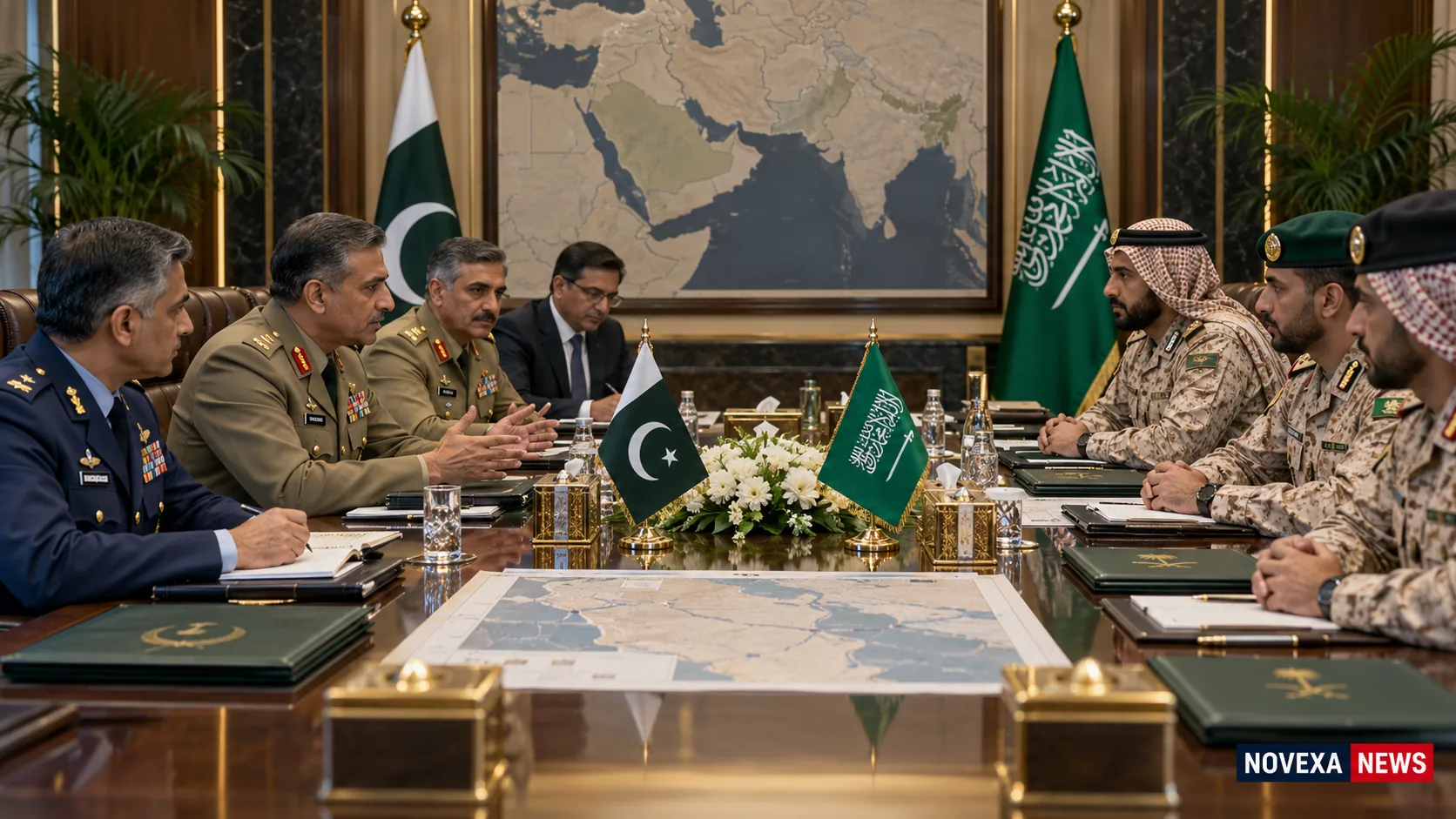
Image credit: AI-generated editorial illustration by Novexa News
Foreign ministers from eight Muslim and Arab countries, including Pakistan, have jointly rejected recent statements by Israeli officials advocating the displacement of Palestinians from the Gaza Strip, warning that any attempt to turn such proposals into government policy could further destabilize the region.
Pakistan, Egypt, Türkiye, Indonesia, Jordan, Qatar, Saudi Arabia and the United Arab Emirates issued a joint statement expressing strong opposition to remarks made by Israeli National Security Minister Itamar Ben-Gvir and Israeli Defense Minister Israel Katz concerning the future of Palestinians in Gaza.
The eight countries said any effort to forcibly remove Palestinians from their homeland would violate international law and international humanitarian law. They stressed that Palestinian civilians must not be subjected to displacement either within the occupied Palestinian territories or beyond them.
What officials reported
The foreign ministers also cautioned that translating such statements into practical measures or official policy could have serious consequences for regional peace and security. They argued that such developments would increase tensions at a time when international diplomatic efforts are focused on finding a political solution to the Gaza conflict.
The ministers further maintained that proposals involving the removal of Palestinians would contradict international efforts aimed at ending the conflict. They specifically referred to US President Donald J. Trump’s Comprehensive Plan to End the Gaza Conflict, noting that the plan does not support the forced displacement of Palestinians.
The joint statement emphasized that Gaza remains an inseparable part of the Occupied Palestinian Territory. According to the eight countries, the territorial integrity of the Palestinian territories must be preserved, including the Gaza Strip, the West Bank and East Jerusalem.
The ministers reiterated their support for a negotiated political settlement based on the two-state solution. They called for the establishment of an independent Palestinian state along the borders that existed before June 4, 1967, with East Jerusalem serving as its capital, in accordance with relevant United Nations resolutions.
Why the joint position matters
The statement brings together countries with different diplomatic relationships and regional priorities around a shared rejection of forced displacement. Its practical impact will depend on whether that position shapes action at the United Nations and in negotiations over Gaza's governance and reconstruction.
International humanitarian law limits forcible transfers and deportations of protected civilians. The ministers' language also reflects concern that population movement imposed by force could become permanent and alter the territorial basis of a future Palestinian state.
What happens next
They also urged the international community to take a firm position against any attempt to alter the demographic or geographical character of the occupied territories. The statement called particular attention to the responsibility of the United Nations Security Council to prevent measures that could create permanent changes on the ground.
The eight foreign ministers reaffirmed their support for the Palestinian people and their right to remain on their land. They rejected efforts that, in their view, could weaken the Palestinian national cause or diminish the legitimate rights of Palestinians.
The coordinated statement reflects continued regional opposition to proposals involving permanent displacement and highlights the broader diplomatic push to preserve Palestinian territorial integrity while keeping a political settlement based on two states at the center of international efforts.
Frequently asked questions
Which countries joined the statement?
Pakistan, Egypt, Turkiye, Indonesia, Jordan, Qatar, Saudi Arabia and the United Arab Emirates.
What did the ministers reject?
They rejected calls for Palestinians to be forcibly displaced from Gaza or elsewhere in the occupied Palestinian territory.
What political outcome did they support?
They reaffirmed support for an independent Palestinian state based on the pre-June 1967 borders, with East Jerusalem as its capital.
Source links
Comments
No approved comments yet.