Dar Urges Stronger OIC Diplomacy on Palestine and Gaza Ceasefire
Ishaq Dar urges coordinated OIC diplomacy to consolidate the Gaza ceasefire, expand humanitarian access and defend Palestinian rights.
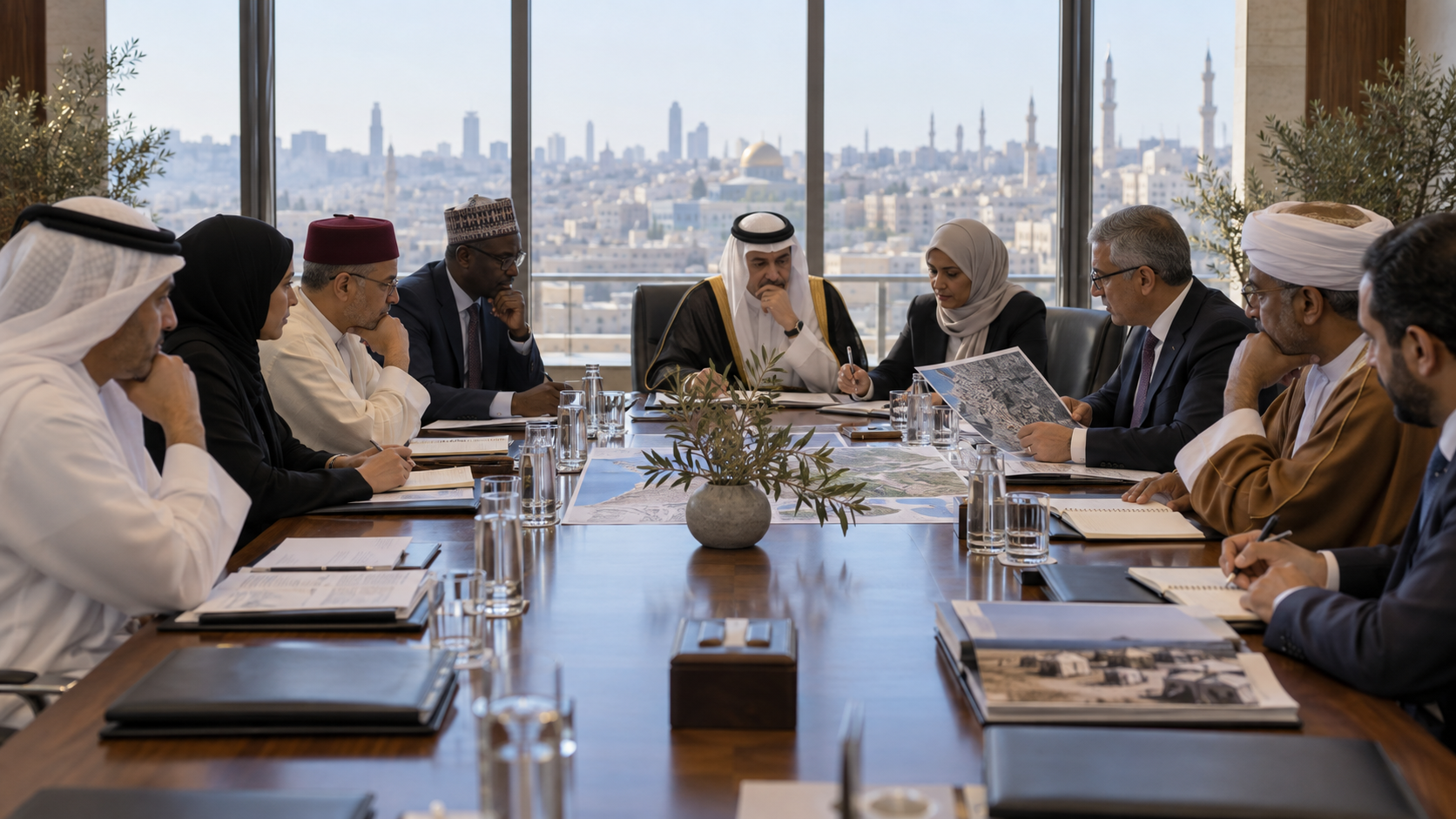
Image credit: AI-generated editorial illustration by OpenAI
Deputy Prime Minister and Foreign Minister Ishaq Dar has called for sustained and coordinated diplomacy by the Organisation of Islamic Cooperation to protect Palestinian rights, consolidate the Gaza ceasefire and ensure that humanitarian assistance reaches civilians without obstruction.
Dar made the appeal during the annual meeting of the OIC Committee of Six on Palestine, held at United Nations headquarters in New York on the sidelines of the 81st session of the UN General Assembly. The gathering brought together foreign ministers and senior representatives to assess the situation in Gaza, the occupied West Bank and East Jerusalem.
According to an OIC account of the meeting, participants placed priority on preserving the ceasefire, moving to the next phase of de-escalation and expanding humanitarian relief. They also discussed international recognition of the State of Palestine and the need for a political process grounded in international law.
Dar said a temporary reduction in fighting must become a durable end to hostilities. He argued that diplomatic attention should remain focused on civilian protection, reliable aid access and a credible path toward Palestinian self-determination rather than fading once immediate violence subsides.
From ceasefire to recovery
The foreign minister urged OIC members to work together at the United Nations and in contacts with influential governments. His remarks linked the ceasefire to the practical questions that follow it: the return of displaced families, restoration of essential services and reconstruction of homes, hospitals, schools and public infrastructure.
Dar said Gaza's recovery should be Palestinian-led and supported by the international community. That position reflects concern among many Muslim-majority states that postwar arrangements must not displace Palestinians or impose a political structure without their consent.
Humanitarian agencies have repeatedly warned that a pause in major combat does not by itself resolve shortages of food, medicine, shelter, clean water and fuel. Predictable access for aid convoys and the reopening of damaged supply routes are therefore central to any effort to stabilise conditions.
Dar welcomed mediation efforts by the United States, Egypt, Qatar and Turkiye. Those countries have played different roles in negotiations, communication with the parties and proposals for de-escalation. Pakistan's position is that their work should be reinforced by broader multilateral pressure and a unified OIC diplomatic message.
West Bank and Jerusalem concerns
The meeting also addressed developments beyond Gaza. Dar raised concern over settlement expansion, settler violence and steps that could amount to annexation in the occupied West Bank. He warned that such actions weaken the territorial basis of a future Palestinian state and deepen instability even when attention is concentrated on Gaza.
East Jerusalem and the status of the Al-Aqsa Mosque compound were another focus. Pakistan has consistently supported preservation of the historic and legal status quo at the holy site and opposed unilateral measures that could alter its character or administration.
These issues matter to ceasefire diplomacy because the Israeli-Palestinian conflict extends across several connected fronts. A reduction in violence in Gaza can be undermined if tensions increase sharply in the West Bank or around religious sites in Jerusalem.
Dar also called for accountability for violations of international humanitarian law. He said durable peace requires more than crisis management and must address the rights and security of Palestinians through recognised legal and political mechanisms.
Coordinated action at the UN
The Committee of Six gives OIC members a forum for aligning positions before engaging with the wider UN membership. A coordinated approach can influence resolutions, humanitarian funding and recognition initiatives, although the organisation cannot by itself enforce a ceasefire or impose a final settlement.
Pakistan supports an independent and viable Palestinian state on the basis of pre-1967 borders, with Al-Quds Al-Sharif as its capital. Dar reiterated that position while urging member states to translate political declarations into sustained diplomatic engagement.
The immediate test will be whether the ceasefire can hold and whether aid delivery expands fast enough to meet civilian needs. The longer-term challenge is to connect de-escalation with reconstruction, accountable governance and a credible political horizon.
Dar's message was that the OIC should remain active on all three tracks. In his assessment, unity among member states is most useful when it produces practical pressure for humanitarian access, opposition to unilateral territorial changes and consistent support for Palestinian statehood.
Source links
Comments
No approved comments yet.