US Cancels South Korea Amphibious Drill, Raising New Questions Over Asia Security Commitments
The United States has cancelled a planned joint amphibious landing drill with South Korea, adding a new layer of doubt over Washington's military posture in Asia as President Donald Trump signals renewed interest in…
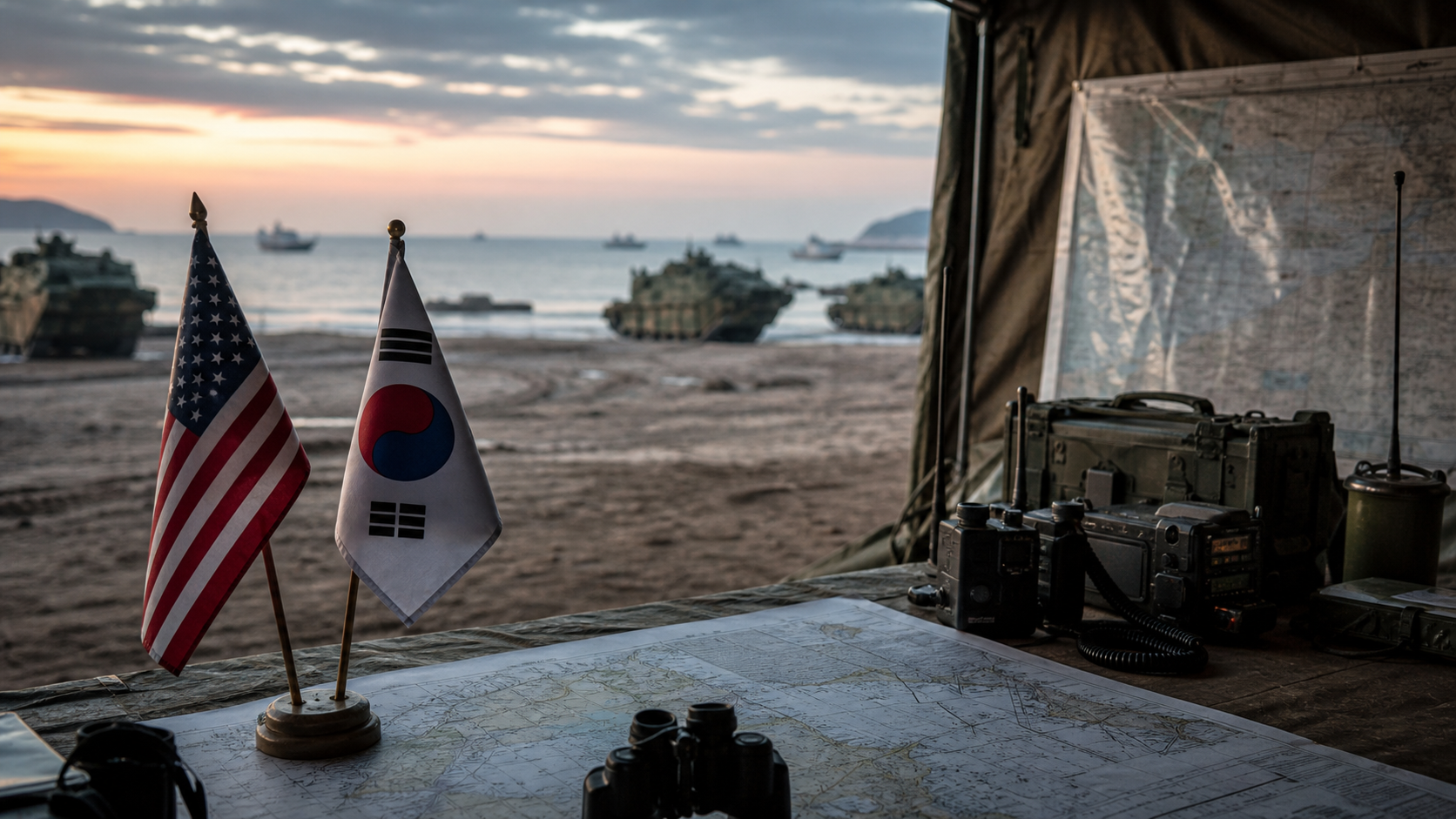
Image credit: AI-generated editorial image
The United States has cancelled a planned joint amphibious landing drill with South Korea, adding a new layer of doubt over Washington's military posture in Asia as President Donald Trump signals renewed interest in diplomacy with North Korean leader Kim Jong Un.
What was cancelled
The cancelled exercise is Ssangyong, a major US-South Korea Marine Corps amphibious drill that had been expected next month. Reuters reported, citing South Korea's Marine Corps, that the US formally told its South Korean counterpart in June that American force availability would be constrained because of commitments linked to the Iran war. The South Korean side said the allies remain in close consultation about resuming the drill.
Why the timing matters
The decision did not land in isolation. It followed Trump's earlier order to substantially reduce the annual Ulchi Freedom Shield exercise, which the allies wrapped up earlier than planned. Trump has complained about the cost of the drills and said they send the wrong signal to Pyongyang. He has also repeatedly described his relationship with Kim Jong Un in personal terms and has shown interest in restarting direct diplomacy.
Readiness versus diplomacy
For Washington and Seoul, joint exercises are more than routine military theatre. They are used to practise command coordination, amphibious operations, rapid reinforcement and responses to possible contingencies on the Korean Peninsula. Scaling them back can reduce friction with North Korea in the short term, but it also raises questions about whether allied forces are losing valuable training time at a moment when Pyongyang continues to develop missile capabilities.
North Korea remains active
North Korea has long condemned US-South Korea exercises as rehearsals for invasion. Yet the reduction of drills has not removed the security problem. Reuters reported that Pyongyang fired 10 short-range ballistic missiles last week and issued a statement denouncing the exercises. That combination leaves Seoul facing an uncomfortable picture: fewer joint training events with Washington, but no clear reduction in North Korean pressure.
Regional allies are watching
The move is also being studied beyond South Korea. Japan, India, Taiwan and other Indo-Pacific partners are likely to assess whether the cancellation was a temporary resource issue caused by the Iran conflict, or a sign of a more transactional US approach to alliances. AP reporting has noted that repeated reductions in exercises can feed concern among allies about the reliability of American security guarantees.
The Iran factor
The Iran war gives Washington a practical explanation for the cancellation: forces, ships and planning capacity are finite. But the political context makes the decision more sensitive. If allies believe US commitments in one region can quickly pull readiness away from another, they may begin hedging their security strategies. That could mean higher defence spending, more independent military planning or louder domestic debates over deterrence.
The US-South Korea alliance remains one of the central pillars of security on the Korean Peninsula. A single cancelled drill does not end that structure. Still, the sequence of reduced exercises, North Korean missile activity and Trump's push for renewed outreach to Kim creates a delicate balance. Washington wants diplomatic space, Seoul wants reassurance, and the region is watching to see whether the alliance can preserve readiness while testing another opening with Pyongyang.
For South Korea, the practical question is what replaces lost training time. Seoul has said consultations with Washington are continuing, but officials have not laid out a full substitute for the cancelled Ssangyong event. If the allies can reschedule, convert some training to smaller units or hold South Korea-led drills, the readiness impact may be limited. If cancellations become a pattern, the political signal will matter as much as the military one.
Source links
Comments
No approved comments yet.