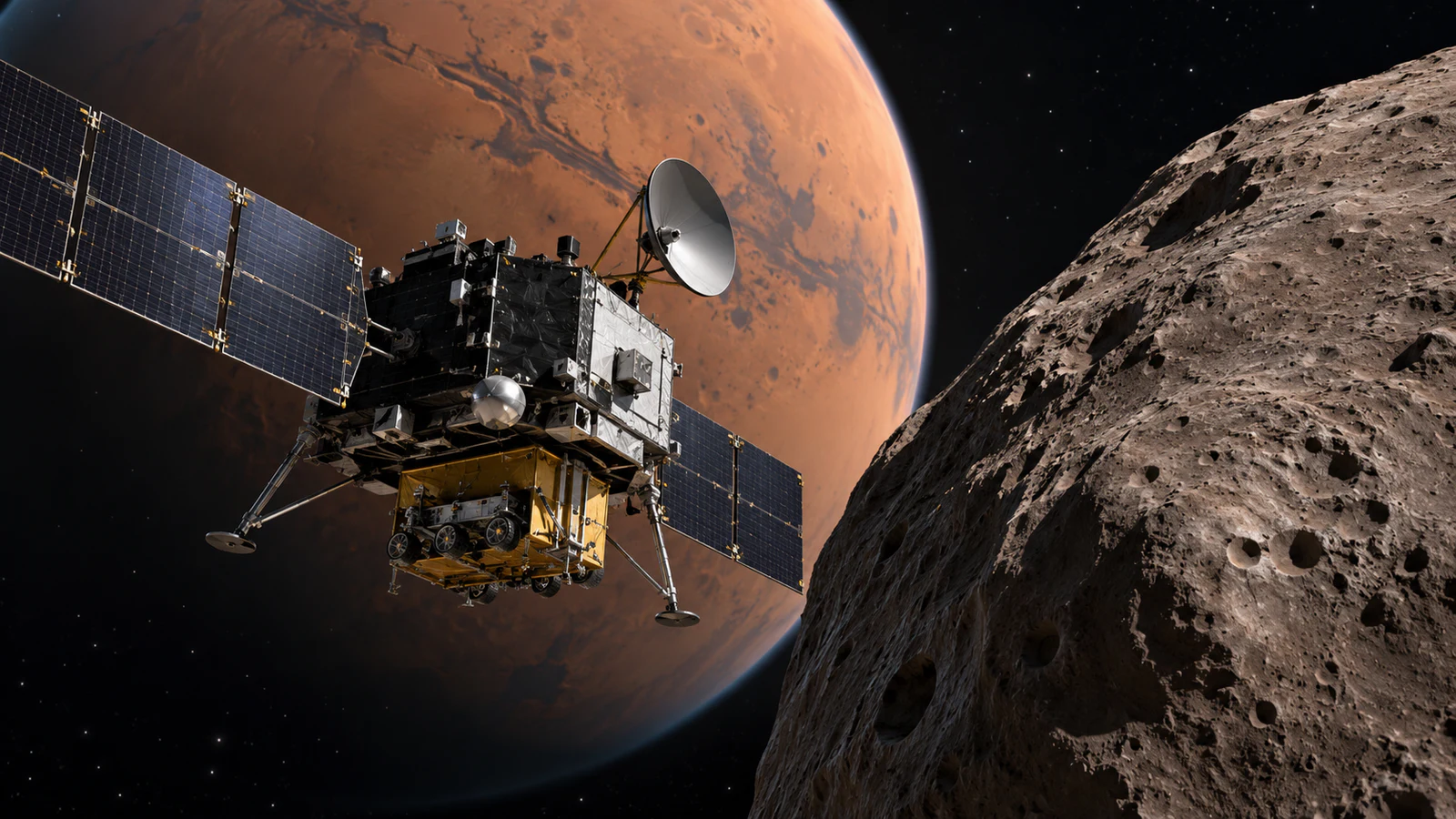
SpaceX Rocket Moon Crash: What Hit the Lunar Surface
A spent SpaceX Falcon 9 upper stage struck the Moon near Einstein Crater. Here is what crashed, why it happened and what scientists can learn.
A spent upper stage from a SpaceX Falcon 9 rocket has struck the Moon after drifting through Earth-Moon space since a commercial lunar launch in January 2025. Scientists tracking the object say its impact occurred on August 5, 2026, near Einstein Crater, close to the Moon's western limb.
The event has generated a surge of searches for terms such as "SpaceX rocket Moon crash" and "Falcon 9 hits Moon." The shorthand is understandable, but it can also create the wrong impression. This was not a crewed spacecraft, an operational rocket or a Falcon 9 booster returning from a new launch. It was the rocket's discarded upper stage, cataloged as 2025-010D, which had completed its job of sending two private lunar landers toward the Moon more than a year earlier.
Researchers had predicted the collision weeks in advance and treated it as both a space-debris event and an unusual scientific opportunity. The impact posed no danger to Earth, astronauts or populated areas. Its importance lies in what it reveals about tracking hardware beyond high Earth orbit, managing discarded rocket stages and studying how high-speed objects disturb the lunar surface.
Did a SpaceX rocket really crash into the Moon?
Yes, according to scientists who tracked the stage and evidence associated with the predicted impact. The Falcon 9 upper stage was expected to reach the lunar surface at approximately 06:35 UTC on August 5.
The actual collision took place far from any observer standing on the surface, and the geometry made direct observation difficult. The predicted site was near Einstein Crater on the sunlit western edge of the Moon, close to the boundary between the near and far sides as viewed from Earth.
Reporting after the scheduled impact said a telescope in Chile detected a debris plume consistent with the collision. The object's orbit had also been followed closely enough that space-tracking specialists regarded an impact as unavoidable once the final trajectory was established.
It is more precise to say that a spent SpaceX rocket stage hit the Moon. Calling it a complete rocket can suggest that an active mission failed during flight, which did not happen.
What exactly hit the lunar surface?
The impactor was the second, or upper, stage of a Falcon 9. A two-stage rocket uses its first stage to provide much of the initial thrust needed to climb away from Earth. The upper stage then continues with the payload, accelerating it toward the orbit or trajectory required by the mission.
Once that delivery work is complete, the upper stage may be left in orbit, directed into Earth's atmosphere or placed on another disposal trajectory. What is possible depends on the mission's energy requirements, remaining propellant and final path.
The object involved in this case was cataloged as 2025-010D. Researchers described it as roughly 12 meters long, comparable to the height of a multi-storey building. Its size and known trajectory made it a significant target for astronomers studying objects in cislunar space, the broad region where the gravitational influence of Earth and the Moon shapes complicated orbital paths.
The stage had already fulfilled its launch purpose. Its later collision therefore did not represent the loss of an active spacecraft.
Which SpaceX mission did the rocket stage support?
The Falcon 9 launched from Florida on January 15, 2025, carrying two commercial lunar landers.
One was Firefly Aerospace's Blue Ghost Mission 1. The other was ispace's second lunar mission, built around the Resilience lander. The shared launch placed the two spacecraft on paths toward the Moon, after which the Falcon 9 upper stage continued on its own trajectory.
Blue Ghost later completed a successful private lunar landing in March 2025. The Resilience mission attempted to land in June but was lost during its descent. Those mission outcomes were separate from the fate of the rocket stage that had originally helped send them away from Earth.
The launch itself accomplished its payload-delivery task. The later Moon impact resulted from what happened to the discarded stage after deployment, not from a launch failure.
When and where did the Falcon 9 stage hit?
Tracking calculations placed the collision at about 06:35 UTC on August 5, 2026. Small differences in published estimates reflected refinements in the object's orbit before impact, but researchers consistently identified the same date and general region.
The target area was near Einstein Crater on the Moon's western limb. The limb is the apparent edge of the lunar disk seen from Earth. Observations there are challenging because surface features are viewed at a sharp angle rather than from directly above.
The location also complicated efforts to watch the impact from Earth. Scientists instead combined precise trajectory calculations with observations of material thrown above the surface. Lunar orbiters can later compare images taken before and after the event to locate the fresh mark and measure its dimensions.
How fast was the SpaceX stage traveling?
Scientists estimated that the upper stage reached the Moon at approximately 2.43 kilometers per second. That equals about 8,700 kilometers per hour or 5,400 miles per hour.
Popular descriptions compare that speed with several times the speed of sound on Earth. The comparison communicates the enormous velocity, although sound does not travel through the vacuum surrounding the Moon in the same way it travels through Earth's atmosphere.
At lunar-impact speeds, even an empty rocket structure can release substantial energy. The stage's motion is converted almost instantly into heat, crushed material and fast-moving lunar dust. A new crater and an expanding plume of ejecta are expected outcomes.
Researchers had modeled the possible plume before the collision. The event therefore offered a chance to compare predictions with observations from telescopes and lunar spacecraft.
Why did the rocket stage crash?
The collision was not planned as a deliberate attack on the Moon, and the upper stage did not suddenly malfunction in August 2026. Its path developed over a long period after the January 2025 mission.
Objects traveling beyond ordinary Earth orbit can enter complex trajectories influenced by Earth, the Moon and the Sun. Small uncertainties grow over time, especially when an object has limited tracking data and no ability to maneuver. Once analysts gathered enough observations of 2025-010D, they determined that the stage's path would intersect the lunar surface.
Preventing such an outcome would have required a different disposal plan or sufficient remaining propellant to direct the stage onto another trajectory. Deep-space launches often operate with narrow energy margins because the rocket must give as much useful velocity as possible to its payloads.
SpaceX said the projected crash was unintentional and that it was working with NASA on ways to avoid similar outcomes. The event has therefore become part of a broader discussion about whether launch providers and mission planners need more consistent end-of-mission standards for hardware sent into cislunar space.
Was anyone in danger?
No. The stage was headed for an unoccupied region of the Moon, and the impact presented no threat to people on Earth.
There are no communities on the Moon, and the predicted site was not close to an active crewed base. Existing lunar spacecraft and landers occupy specific locations separated by large distances. Researchers tracking the stage were able to estimate its destination well before the collision.
The crash also could not knock the Moon out of its orbit or produce any meaningful effect on Earth. The Moon is vastly more massive than a rocket stage, and it is struck naturally by meteoroids. Although the collision was energetic on the scale of a manufactured object, it was negligible on a planetary scale.
Why does the Moon crash matter scientifically?
A known artificial impact gives researchers information that random natural impacts often cannot provide. Astronomers had estimates for the stage's dimensions, mass, trajectory and speed. Those constraints help them test models of crater formation, dust movement and the visibility of impact plumes.
The event can also help teams prepare for future lunar seismic experiments. If instruments are operating on or near the Moon when an object with a known path strikes, scientists can compare the impact energy with vibrations traveling through the lunar interior.
Before-and-after orbital imagery may reveal the new crater, changes in brightness and the distribution of disturbed material. Those observations can improve understanding of how lunar soil behaves when hit at high speed.
There is also a practical tracking lesson. Space agencies and commercial companies are planning more missions between Earth and the Moon. Accurately locating discarded stages and inactive spacecraft will become increasingly important as that region grows busier.
Does this count as space junk?
The spent stage is a form of human-made space debris, although it was traveling far beyond the crowded low Earth orbit where most discussions of space junk take place.
Debris near Earth raises immediate concerns because fragments can collide with satellites, crewed spacecraft or one another. Cislunar debris presents a different challenge. Objects can remain difficult to detect, follow unstable paths and eventually encounter the Moon or return toward Earth.
The Falcon 9 stage is not the first manufactured object to hit the Moon. Some missions have deliberately crashed hardware for science or disposal, while other stages have arrived unintentionally. A rocket body associated with a Chinese lunar mission struck the Moon in 2022 after initially being misidentified by some observers.
What makes the 2026 event notable is the level of advance tracking and the opportunity to coordinate observations. It provides a documented case that policymakers and engineers can use when considering future disposal rules.
Did the crash damage the Moon?
The collision almost certainly created a fresh crater and displaced lunar soil, but "damage" requires scale and context.
The Moon's surface is covered with craters formed by impacts over billions of years. Natural objects routinely strike it because the Moon lacks a thick atmosphere capable of burning them up. A rocket-stage crater is scientifically interesting and represents another piece of human material on the lunar surface, but it does not threaten the Moon as a celestial body.
The more relevant environmental concern is cumulative. As lunar activity expands, repeated discarded hardware, failed landers and intentional impactors could complicate scientific sites or leave material in regions that countries and companies hope to explore. That is why researchers describe lunar litter as an issue worth addressing before traffic becomes much heavier.
Frequently asked questions
Was this Starship?
No. The object was a spent upper stage from a Falcon 9 launch, not SpaceX's Starship vehicle.
Did the Falcon 9 booster hit the Moon?
No. The object was the expendable upper stage. The first-stage booster is a different part of the Falcon 9 system.
Was the Moon crash intentional?
SpaceX said the impact was not deliberate. The stage entered a trajectory that eventually led to the Moon after completing its 2025 payload mission.
Could the impact be seen from Earth?
The collision site was difficult to observe directly, but astronomers reported evidence of a debris plume. Orbital before-and-after images can provide additional confirmation and measurements.
Will the crash affect Earth?
No. The impact was too small relative to the Moon to alter its orbit or create a danger for Earth.
What happens next?
Scientists will study telescope observations and orbital imagery to identify the impact site and compare the real crater with pre-impact predictions. Those measurements can refine models for future artificial and natural lunar collisions.
Mission planners are also likely to examine how the stage was disposed of and whether similar deep-space launches can reserve enough capability for safer end-of-mission paths. There is no single simple solution: every additional maneuver requires propellant, tracking and coordination. But the growing number of lunar missions makes disposal planning harder to postpone.
The SpaceX rocket Moon crash was not a new launch disaster and did not endanger Earth. It was the final event in the long, uncontrolled journey of a discarded Falcon 9 upper stage. Its collision near Einstein Crater has now turned a piece of space debris into a useful case study for lunar science and a warning about managing traffic beyond Earth's familiar satellite orbits.
Comments
No approved comments yet.