PM Shehbaz Orders Early Export Roadmap Rollout
## Prime minister pushes faster export reforms Prime Minister Shehbaz Sharif has directed officials to move quickly on the approved Strategic Roadmap for Export Promotion, placing exports at the centre of the…
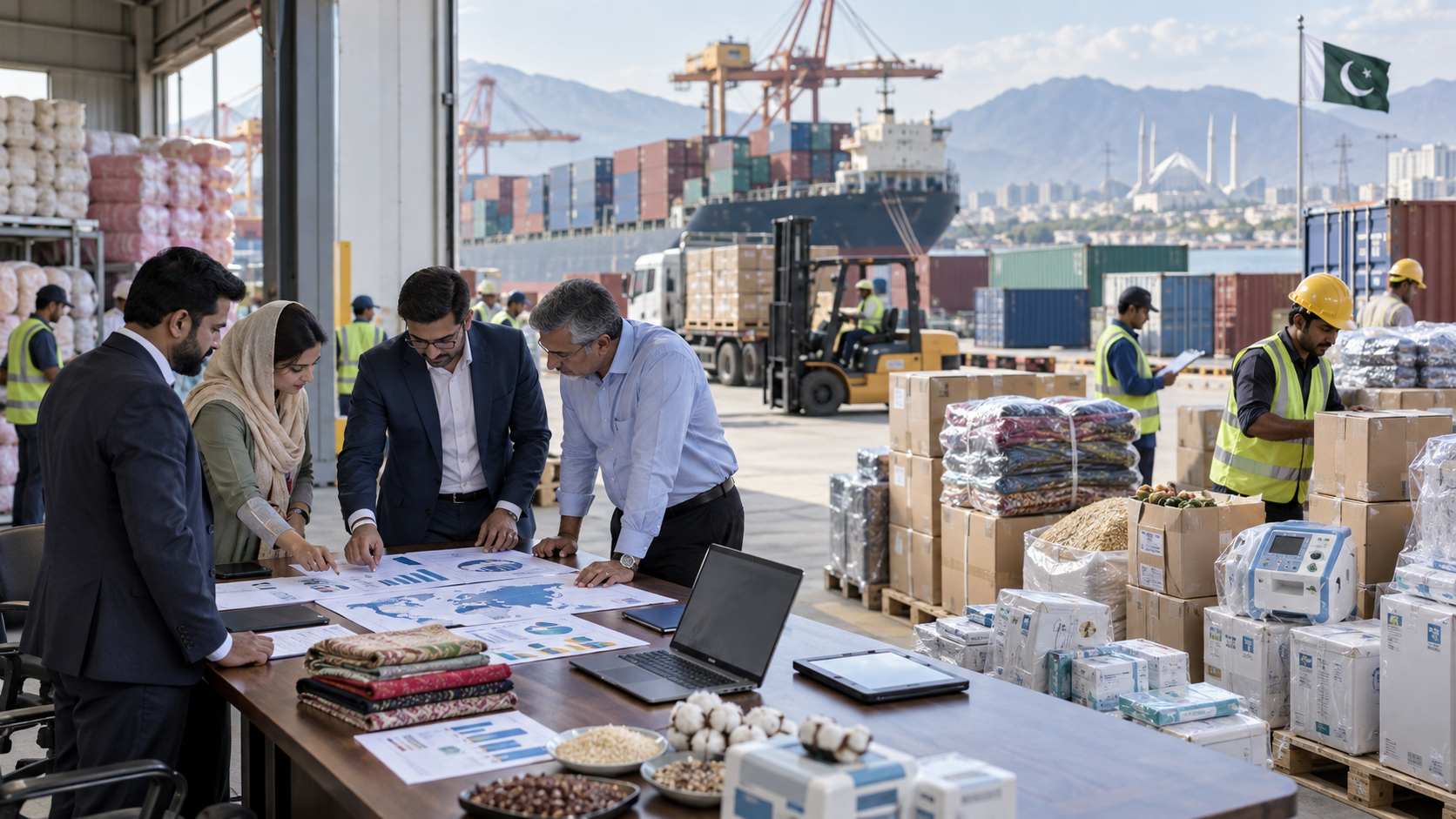
Image credit: AI-generated editorial image / Novexa News
Prime minister pushes faster export reforms
Prime Minister Shehbaz Sharif has directed officials to move quickly on the approved Strategic Roadmap for Export Promotion, placing exports at the centre of the government's economic recovery plan. The directions were issued during a high-level review meeting on improving exports and accelerating economic activity.
The prime minister said Pakistan needs broader access to international markets, better product quality and a wider export base. His message was not limited to traditional sectors such as textiles. He asked authorities to prepare more industries and products for buyers abroad so that export growth is not dependent on a narrow set of goods.
Diversification is the main policy theme
Pakistan has long struggled with a limited export basket. Textiles remain central, but the government now wants agriculture, horticulture, surgical instruments, engineering goods, minerals, food products and technology-linked sectors to contribute more. The roadmap discussed in the meeting is meant to identify markets, remove bottlenecks and help companies meet international standards.
Shehbaz Sharif also directed officials to bring as many sectors as possible into export activity. That means helping companies move from domestic supply chains into global competition, where quality certification, pricing, packaging, timely delivery and after-sales reliability often decide whether contracts are won or lost.
Quality and standards become a priority
A major part of the meeting focused on standards. The prime minister urged relevant authorities to ensure Pakistani products are tested according to international requirements. For exporters, this can mean laboratory certification, compliance with food safety rules, medical equipment approvals, traceability, environmental standards and documentation that satisfies foreign buyers.
Without those systems, market access can remain theoretical. A product may be competitive on price but still fail to enter a market if it does not meet testing or compliance rules. The government's latest push suggests it wants quality assurance to be treated as export infrastructure, not as a final paperwork step.
Trade agreements and new markets under review
The meeting also reviewed proposals for expanding market access through existing free trade agreements and possible new preferential trade arrangements with friendly countries. Pakistan is looking for a mix of tariff relief, easier entry into regional markets and better positioning for sectors that already have some export capacity.
Agricultural and horticultural exports received particular attention. Pakistan has potential in food and farm products, but exporters often face losses because of weak cold chains, inconsistent grading, packaging issues and limited branding. Officials were asked to consider steps that would improve the country's international presence in those categories.
Surgical and medical equipment in focus
The government also discussed ways to help surgical and medical equipment exporters compete in international tenders, including procurement processes for hospitals abroad. Pakistan's surgical industry already has a reputation in several markets, but tender participation requires documentation, financing, certification and the ability to meet delivery schedules at scale.
International exhibitions are also part of the roadmap. Planned events covering textiles, health engineering, minerals, food and agriculture are expected to connect Pakistani producers with buyers in major cities. Such exhibitions can help, but only if they are backed by follow-up, financing support and reliable production capacity.
Export numbers show why the push matters
The policy direction comes after a difficult export year. Pakistan Bureau of Statistics data cited in coverage of the meeting showed merchandise exports rose 9.54 percent year-on-year in the first month of FY27, but that followed a weak FY26 in which exports fell by 5.97 percent and missed the annual target by $4.87 billion.
The government has described export-led growth as a key budget priority. It has also completed restructuring of the Export Development Fund and is working on intellectual property law changes to encourage innovation. The real test will be implementation: whether exporters see faster procedures, fewer administrative hurdles and practical help in meeting buyer standards.
For Pakistan's economy, the export roadmap is not only a trade document. It is a test of whether the country can shift from periodic balance-of-payments pressure toward a more competitive, outward-looking growth model.
Source links
Comments
No approved comments yet.