Pakistan Looks to Smarter Irrigation as Water Pressures Mount
Pakistan's agriculture sector is looking to laser land levelling, better irrigation scheduling and practical farm advice to produce more with limited water.
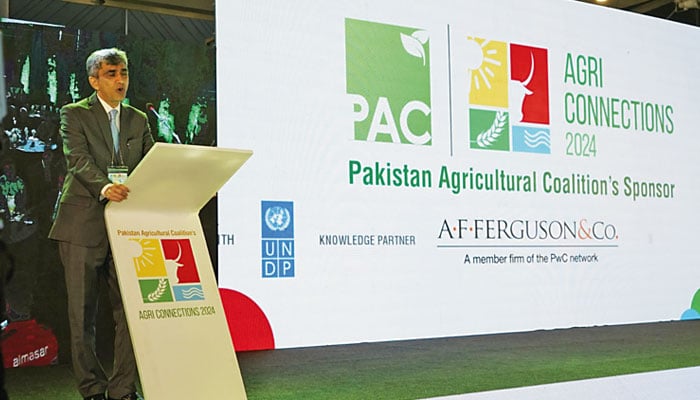
Image credit: The News / Agri-Connections 2024 file photograph
LAHORE, October 1, 2026: Pakistan must improve the amount of food produced from each unit of water as population growth, climate stress and tightening supplies place greater pressure on agriculture, an industry executive told the Agri-Connections 2026 conference in Lahore.
Zeeshan Haseeb Baig, country general manager of Syngenta Pakistan, said farmers need practical tools and timely information that can help them make better decisions about land preparation, irrigation and crop management. His remarks were reported by The World News AM during the two-day agriculture conference at Lahore Expo Centre.
Baig presented laser land levelling as an example of an established technology that can improve both irrigation efficiency and crop performance. He said its use in central Punjab could reduce water consumption by about 20 to 30 percent while lifting crop yields by roughly 10 percent.
The figures are broadly consistent with information published by the Punjab Agriculture Department. Its assessment says precision laser levelling can cut irrigation time by approximately 25 to 32 percent and improve crop yields by about 11 to 13 percent, although results can vary by crop, field and local conditions.
Laser-guided equipment creates a more uniform field surface, allowing irrigation water to spread more evenly. Better distribution can reduce pooling, runoff and the need to keep water flowing simply to reach higher sections of a field. The process may also support more consistent germination and fertilizer use.
Practical Technology at Farm Level
Baig argued that agricultural gains do not always depend on complex or expensive systems. Relatively simple interventions can make a meaningful difference when they reach farmers at the point where decisions are taken.
That support can include weather information, agronomic advice, field assessments and guidance tailored to a crop's water requirements. Used together, these tools can help farmers move away from routine irrigation schedules and respond more closely to soil moisture, weather and plant needs.
The emphasis is on water productivity: measuring how effectively water is converted into crops and farm income, rather than treating higher water use as the main route to higher production. This distinction is increasingly important for an agriculture system that depends heavily on irrigation and faces greater variability in water availability.
Punjab is central to the issue because of its large contribution to Pakistan's food production. Improvements adopted across many farms could therefore have an effect beyond individual growers, reducing avoidable losses while strengthening the reliability of agricultural supply chains.
Research on Pakistan's rice-wheat farming systems has also found that laser land levelling can save irrigation water and improve yields and household income. The results, however, depend on access to equipment, operator skill, field conditions and farmers' ability to obtain services at an affordable price.
Punjab Expands Water-Efficiency Support
The provincial government is already promoting the technology through its Programme for Water Efficient Agriculture, which runs from 2025-26 to 2027-28. The programme includes support for 1,000 laser land levellers, improvements to community irrigation networks and training for farmers and rural service providers.
According to the Agriculture Department, the programme has a planned cost of approximately Rs7.81 billion and aims to improve irrigation-water conveyance efficiency by 20 percent in participating canal-command areas. Its design also seeks to expand rental services so growers who cannot buy specialised machinery can still use it.
Access remains as important as the technology itself. Small farmers may struggle with upfront costs, limited availability of trained operators or weak extension services. Equipment subsidies and rental networks can help, but long-term results also require maintenance, farmer training and reliable advice on when levelling should be repeated.
The discussion took place during Agri-Connections 2026, organised by the Pakistan Agricultural Coalition on October 1 and 2. The event's theme was food security and agricultural investment in the era of climate change. The Punjab government partnered with the coalition, while the World Bank, International Finance Corporation and UN Food and Agriculture Organization participated as session partners, according to The News.
For Pakistan, the wider challenge is to turn isolated efficiency gains into routine farming practice. Precision land preparation, better irrigation scheduling and timely advice cannot resolve every constraint facing agriculture, but they can help protect production while reducing pressure on scarce water resources.
Source links
Comments
No approved comments yet.
Related Articles
 Punjab Approves 2027 Basant Festival in Lahore with Enhanced Safety Measures
 Prime Minister Shehbaz Sharif Calls for Higher Agricultural Productivity and New Export Markets
 Saudi Arabia and Pakistan Deepen Agriculture Cooperation