Kyiv Depot Blast Kills 37 After Russian Drone Strike
A Russian drone strike on a warehouse in Myla triggered ammunition explosions that killed at least 37 people and forced hundreds to evacuate.
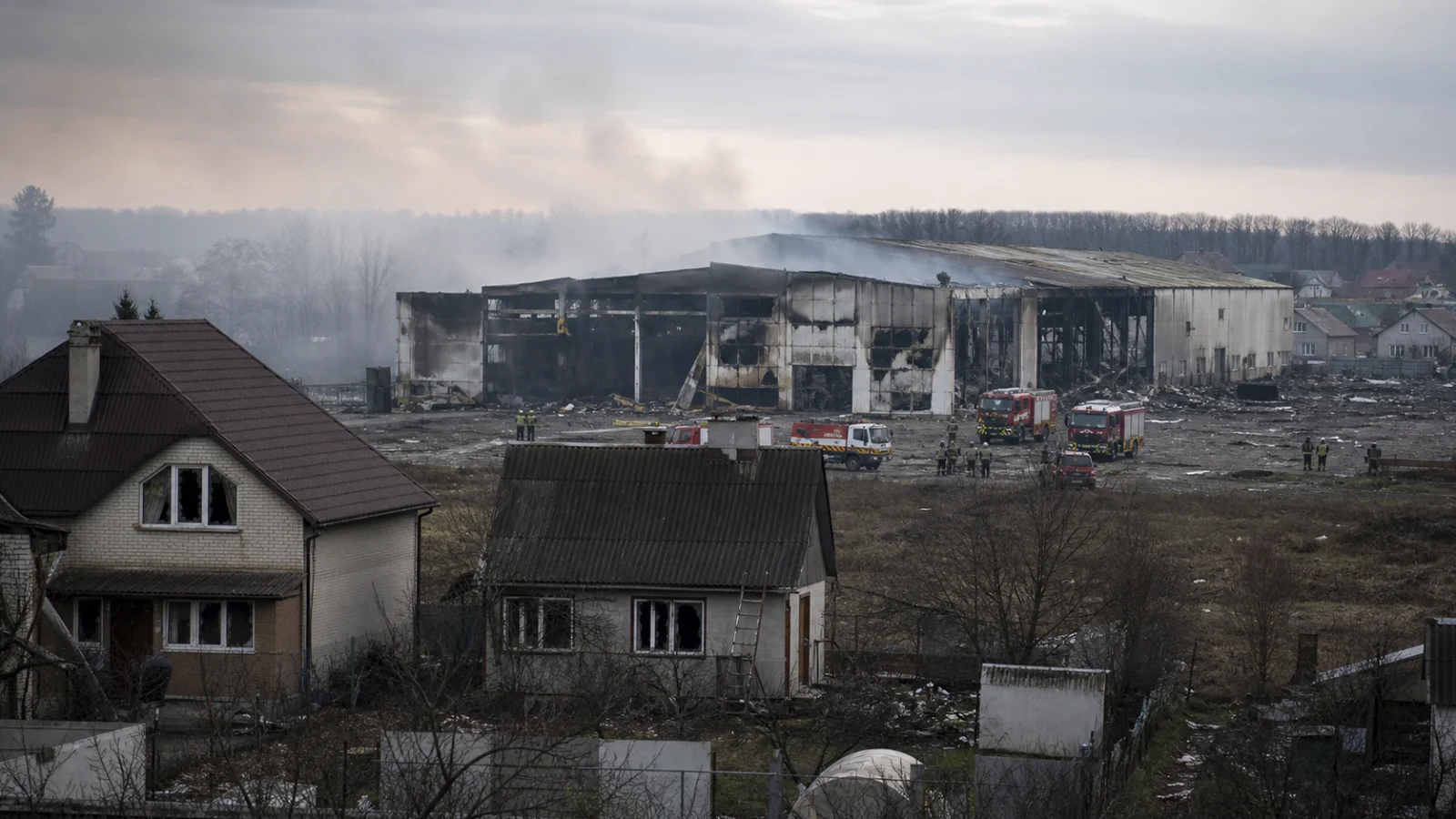
Image credit: AI-generated editorial illustration by Novexa News
A Russian drone strike on a warehouse west of Kyiv set off a chain of explosions that killed at least 37 people, injured dozens and damaged homes in the village of Myla, Ukrainian authorities said. More than 370 residents were evacuated as emergency crews dealt with fires, unstable buildings and the danger posed by unexploded ammunition.
The attack late on Friday, August 28, hit a warehouse in Myla in the Bucha district. Ukrainian officials said shells, mines, drones and other explosive material stored at the site began detonating after the strike. Fires then spread into nearby residential areas and a care facility for elderly people and people with disabilities.
The Associated Press reported that 34 of those killed were residents of the care home, citing the head of the Kyiv regional military administration. Officials initially reported 42 injured people, including four children, although casualty figures can change as hospitals and rescue teams reconcile their records.
What happened in Myla?
Residents described a drone hitting the warehouse at about 8 p.m., followed by repeated blasts. The secondary explosions made the incident far more destructive than the initial impact and complicated the work of firefighters trying to reach nearby buildings.
At least 50 residential properties were damaged to varying degrees. Windows were blown out, walls cracked and roofs were hit by debris. Authorities closed part of the main highway west of Kyiv while crews moved residents away from the danger zone and checked the surrounding area.
The warehouse's proximity to homes has become a central part of the investigation. President Volodymyr Zelenskyy said Ukrainian law prohibits ammunition from being stored near residential buildings and described the apparent storage failure as serious negligence. Criminal proceedings were opened to determine who was responsible for the facility and whether military storage rules were breached.
Ukraine opens negligence investigation
The investigation has two distinct elements. Ukrainian authorities are examining the Russian strike itself as part of the wider war, while prosecutors are also reviewing decisions that may have exposed civilians to the secondary explosions.
Investigators are expected to establish what was stored at the warehouse, who authorised its use and what safety measures were in place. They will also need to determine whether the nearby care facility and households had been informed of the risk or given evacuation procedures.
The inquiry follows another deadly depot incident near Kyiv in July. Ukrainian Prime Minister Serhii Koretskyi referred to that earlier strike while criticising the failure to prevent another large ammunition detonation close to civilians. The comparison has added pressure for a wider audit of military storage sites.
Russia's Defence Ministry said its forces had targeted an ammunition depot in Myla. Moscow claimed the site held components and launch equipment linked to long-range Ukrainian drones. Those claims have not been independently verified in full, but Ukrainian officials acknowledged that explosive military material was stored at the warehouse.
Rescue and evacuation work continues
Emergency teams searched damaged structures while explosive specialists assessed debris around the depot. Their task was slowed by intermittent detonations and the possibility that shells or mines had been thrown beyond the main warehouse area.
Evacuated residents faced uncertainty over when they could safely return. Even homes that remained standing required checks for structural damage, broken utility lines and explosive fragments. Local authorities also had to arrange temporary accommodation and care for people displaced from the elderly and disability facility.
The disaster occurred during a sustained period of Russian aerial attacks on Kyiv and other Ukrainian regions. Air-defence units intercepted many incoming drones, according to Ukrainian officials, but some reached their targets or fell in populated areas. A separate strike in Kyiv killed a young child during the same wave of attacks.
Why did the depot strike cause so much damage?
The scale of the Myla blast was driven by secondary detonations. When stored ammunition catches fire, individual shells and explosive components can ignite over an extended period, expanding the danger zone and sending fragments into surrounding property. Firefighters may be unable to approach until the rate of explosions falls.
That risk is why military storage rules generally require separation from civilian buildings, controlled access, fire protection and careful limits on how material is grouped. The criminal investigation will determine which rules applied at Myla and whether they were followed.
The Russian strike remains the immediate cause of the disaster, while the storage inquiry addresses whether the human toll was worsened by preventable decisions on the Ukrainian side. Treating those as separate questions is essential to understanding both responsibility for the attack and responsibility for civilian protection.
Frequently asked questions
How many people were killed in the Myla warehouse blast?
Ukrainian authorities reported at least 37 deaths. The toll included 34 residents of a nearby care facility, according to a regional official cited by the Associated Press.
Where is Myla?
Myla is a village in the Bucha district west of Kyiv, close to the main road connecting the capital with western Ukraine.
Why is Ukraine investigating its own officials?
The investigation concerns the alleged storage of ammunition near homes and a care facility. It is separate from Ukraine's investigation of the Russian attack itself.
Search, recovery and safety work remained active as of August 30. Any revised casualty total should be attributed to Ukrainian emergency or regional authorities because conditions at the site are still changing.
*The accompanying image is an AI-generated editorial illustration and does not show the actual Myla strike or its victims.*
Source links
Comments
No approved comments yet.