Bishkek SCO Summit Brings Major Powers Together
The September 1 SCO summit in Bishkek will bring the leaders of China, Russia, India, Iran, Pakistan and Central Asian states together amid global tensions.
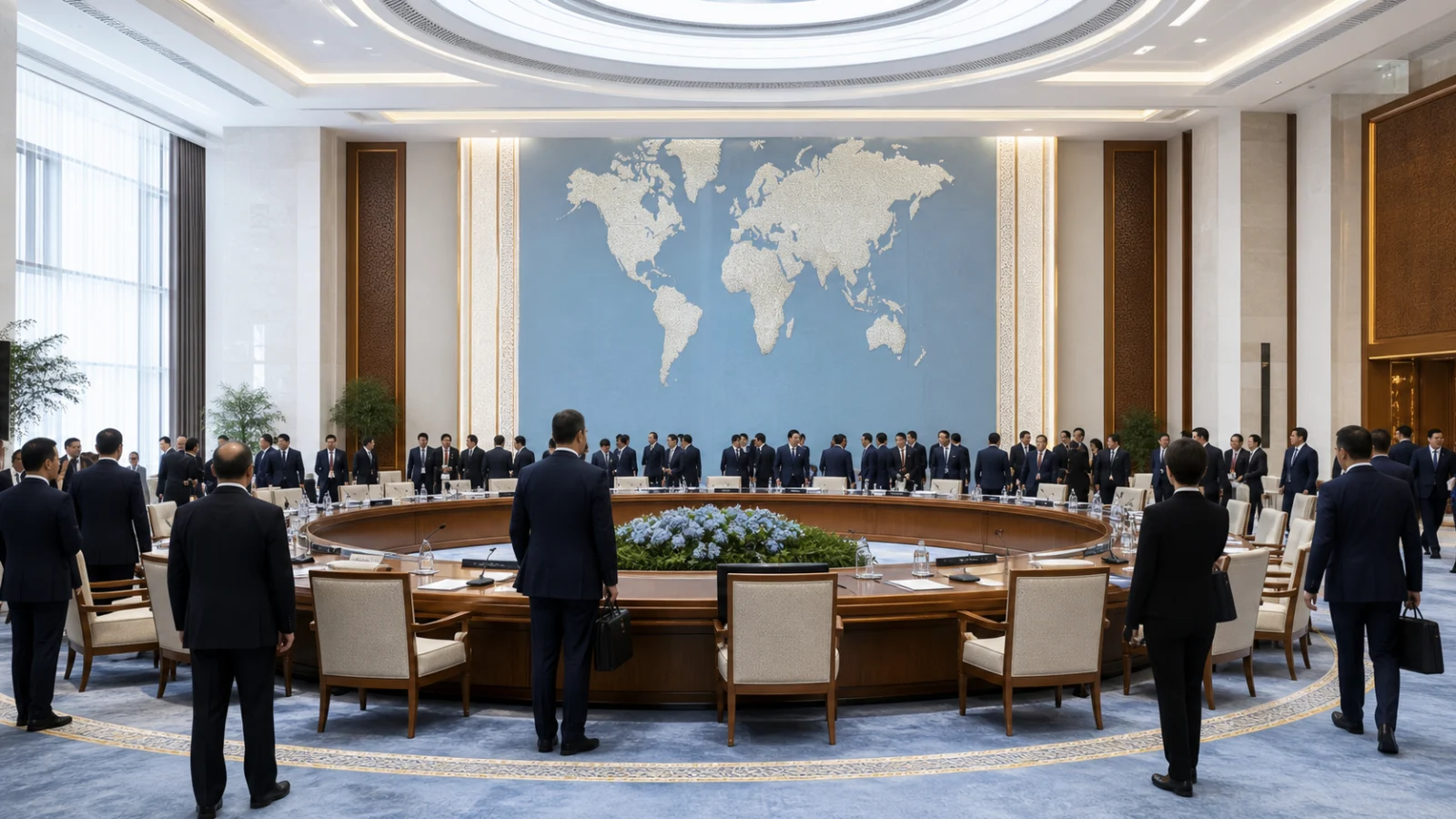
Image credit: AI-generated editorial illustration by Novexa News
Bishkek is preparing to host one of the year's most closely watched diplomatic gatherings as leaders from across Eurasia arrive for the Shanghai Cooperation Organisation summit on September 1.
The meeting will be chaired by Kyrgyz President Sadyr Japarov and will include a regular session of the SCO Council of Heads of State as well as an SCO Plus gathering. Chinese President Xi Jinping, Russian President Vladimir Putin, Indian Prime Minister Narendra Modi, Iranian President Masoud Pezeshkian and Pakistani Prime Minister Shehbaz Sharif are among the leaders expected to attend.
Their presence gives the summit importance beyond its formal agenda. The participants represent countries with major populations, large economies, nuclear capabilities and direct interests in some of the world's most difficult security disputes.
A summit shaped by global tension
The SCO meeting comes while the international system is under pressure from the war in Ukraine, conflict involving Iran and the United States, instability in Afghanistan and persistent disruption to trade and energy routes. These crises affect SCO members differently, but none can treat them as distant problems.
Russia is seeking political and economic relationships that can withstand Western sanctions. Iran, which became a full SCO member in 2023, is also trying to deepen trade with non-Western partners while managing military and economic pressure. China remains a critical commercial partner for both countries and has promoted a larger diplomatic role for regional institutions.
India and Pakistan bring their own security priorities to the table. Their difficult bilateral relationship can limit consensus, yet both see value in a forum that provides direct access to Central Asian governments and the major powers surrounding the region.
Why the SCO matters after 25 years
The organisation traces its origins to the Shanghai Five grouping created in 1996 and was formally established as the SCO in 2001. The Bishkek meeting marks its 25th anniversary.
What began primarily as a platform for border confidence-building and regional security has expanded into economic, transport, energy and diplomatic cooperation. Its enlargement has increased its political weight, but it has also made agreement more difficult because members do not share a single foreign-policy outlook.
China and Russia often use the SCO to support a more multipolar international order and to emphasise sovereignty and non-interference. Central Asian members, however, must balance relations among Moscow, Beijing, Western partners and neighbouring states. India maintains close ties with Russia while also expanding strategic cooperation with the United States and other Indo-Pacific partners.
The SCO's value therefore lies less in acting like a tightly integrated alliance and more in keeping countries with competing interests in the same diplomatic room.
Pakistan's priorities in Bishkek
For Pakistan, the summit offers an opportunity to advance regional connectivity, trade, energy cooperation and security coordination. Islamabad's geography places it between China, Central Asia, the Middle East and the Arabian Sea, but geography alone does not create a trade corridor.
Transport links require reliable border procedures, functioning rail and road networks, financing, security and predictable commercial rules. Pakistan can use bilateral meetings in Bishkek to seek practical progress in these areas, particularly with Central Asian states looking for access to southern ports.
Energy will also be important. Pakistan has long explored electricity and gas links with Central Asia, where suppliers are seeking additional markets. Projects can move slowly because of cost, security concerns and regional politics, so leaders will be judged by whether broad commitments lead to executable agreements.
Security discussions are likely to include Afghanistan and the risk posed by militant networks operating across borders. Member states agree that instability is dangerous, but they do not always agree on how to engage Kabul or define the responsibilities of regional governments.
Bilateral meetings may produce the clearest results
Large summits often conclude with carefully negotiated declarations, but their most useful work can happen in smaller meetings on the sidelines. Leaders can address trade obstacles, coordinate positions before international votes and discuss disputes that would be difficult to raise publicly.
Putin is expected to meet Xi and Pezeshkian during the visit. Modi, Sharif and Central Asian leaders will also have opportunities for direct engagement. These conversations may not produce immediate public agreements, but they can establish the political instructions needed for officials to continue negotiations.
Consensus remains the organisation's central test
The SCO's diversity is both its strength and its weakness. A forum that includes China, Russia, India, Pakistan and Iran commands attention, yet their strategic interests frequently diverge.
India and China have an unsettled border relationship. India and Pakistan remain divided by long-running disputes. Russia and China cooperate closely but also have overlapping interests in Central Asia. Iran's confrontation with Washington introduces another source of pressure.
The organisation is unlikely to resolve those problems in a single summit. A more realistic standard is whether it can prevent disagreements from blocking cooperation in areas where interests overlap, including transport, counterterrorism, food security and emergency response.
What to watch on September 1
The summit's declaration will show how members describe current wars, sanctions and regional security. Any language on Afghanistan, cross-border militancy, trade corridors and settlement of disputes will be closely examined.
For Pakistan, the most meaningful outcomes would be concrete investment conversations, clearer connectivity plans and sustained engagement with Central Asian economies. For the wider SCO, the question is whether its growing membership can produce practical coordination rather than ceremonial unity.
The Bishkek summit brings major powers together at a moment when direct communication is unusually valuable. Its success will depend on what governments carry forward once the group photographs and formal speeches are over.
*The featured image is an AI-generated editorial illustration by Novexa News and does not depict the actual summit.*
Source links
Comments
No approved comments yet.