Are Argentina Being Treated Favourably at World Cup 2026?
Argentina's run to the World Cup final has included disputed VAR calls, but controversial decisions are not proof of a FIFA conspiracy.

Image credit: BBC Sport / Getty Images
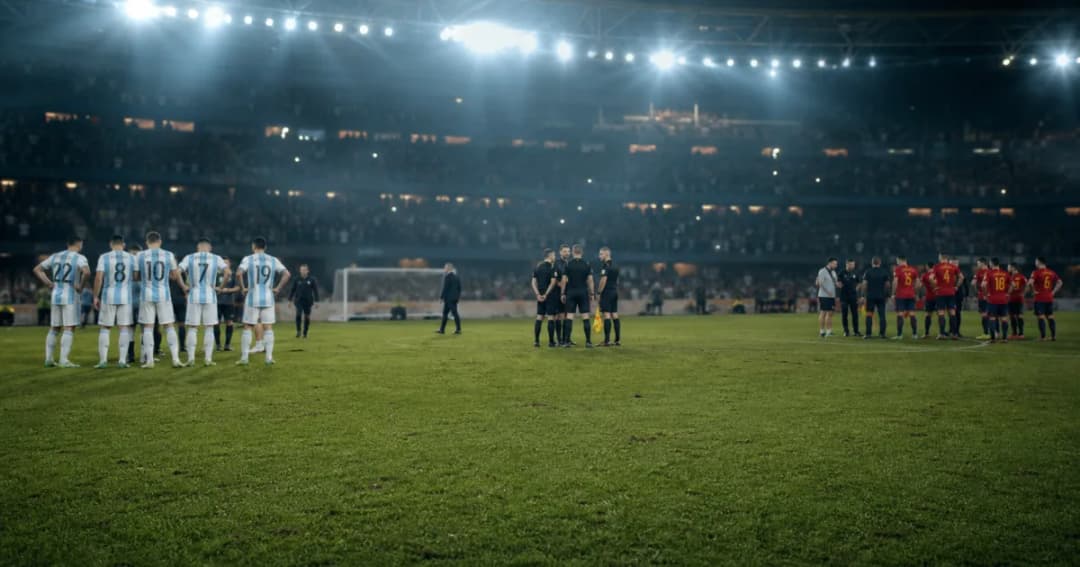
July 17, 2026: Argentina will face Spain in the World Cup final after surviving a knockout run marked by dramatic comebacks, disputed refereeing decisions and accusations that officials have favoured Lionel Messi and the defending champions.
Egypt made the strongest allegations after losing 3-2 in the round of 16 despite leading by two goals with 11 minutes remaining. Its football association criticised the match officials and the use of the video assistant referee, while coach Hossam Hassan suggested there had been pressure to keep Argentina and Messi in the tournament.
The complaints have since become part of a wider debate about decisions in Argentina's victories over Switzerland and England. The record shows several contentious calls that benefited Argentina. It does not, however, establish that FIFA or its referees engineered the team's route to the final.
Why Egypt felt wronged
Egypt's anger centred on two sequences. Mostafa Zico had a goal disallowed after VAR identified a foul by Marwan Attia on Lisandro Martinez earlier in the attacking phase. Later, Mohamed Salah went down under a challenge from Julian Alvarez shortly before Enzo Fernandez scored Argentina's stoppage-time winner.
FIFA refereeing chief Pierluigi Collina defended both decisions. He said VAR was entitled to intervene because the referee had missed the foul on Martinez. He also said the contact between Alvarez and Salah was judged to be normal football contact rather than a penalty.
Those explanations did not erase Egypt's frustration. The similarity between the two passages of play made the decisions appear inconsistent to many viewers: one contact was used to cancel an Egyptian goal, while another was not considered sufficient to stop the move that produced Argentina's winner.
The distinction under the laws of the game is that not every instance of contact is a foul. That makes the referee's judgement central and leaves room for disagreement, particularly when one decision is reviewed on a screen and another is allowed to stand.
Further controversy against Switzerland
Argentina's quarter-final against Switzerland produced another unusual intervention. Referee Joao Pedro da Silva Pinheiro initially awarded Breel Embolo a free kick after a challenge by Leandro Paredes and booked the Argentina midfielder.
VAR then advised the referee that Embolo had simulated the foul. Pinheiro reversed the decision, removed Paredes' yellow card and booked Embolo instead. Because it was Embolo's second caution, Switzerland were reduced to 10 players before Argentina won 3-1 after extra time.
The controversy was not simply whether Embolo had dived. Questions were also raised about whether VAR should have intervened under the protocol for mistaken identity when the referee had apparently made a judgement about the challenge itself. UEFA has instructed its own officials not to treat simulation cases in that way, according to the original BBC Sport analysis.
Different competitions can issue different operational guidance, but the episode reinforced the perception among critics that Argentina had received the benefit of a debatable interpretation at a decisive moment.
Decisions in the England semi-final
England supporters also questioned two incidents in Argentina's 2-1 semi-final victory. Enzo Fernandez avoided a red-card review after an early challenge from behind on Elliot Anderson, while some argued that Messi fouled Djed Spence before Argentina's winning goal.
Neither incident proves bias. Both add to the concern about consistency because comparable challenges elsewhere in the tournament produced different outcomes. Refereeing decisions are judged in context, but supporters expect the same threshold to be applied across matches and teams.
Messi had also escaped punishment for a high challenge on Algeria captain Aissa Mandi during the group stage. A similar incident involving United States forward Folarin Balogun initially led to a red card against Bosnia-Herzegovina, although that sanction was later overturned.
Had Messi been sent off, a suspension could have changed his participation in later group matches. He went on to score eight goals before the final and became the leading scorer in men's World Cup history with 21.
A favourable route is not evidence of fixing
FIFA separated the four highest-ranked teams in the draw so they could not meet before the semi-finals if they won their groups. The format was intended to preserve major fixtures for the latter stages, but it also shaped the difficulty of each contender's route.
Argentina faced Cape Verde, Egypt and Switzerland before meeting England. Spain and France encountered more top-10 opposition earlier in the knockout rounds. Argentina have also been awarded three penalties at this tournament, more than any other team, after receiving a record five during their 2022 title run.
Those numbers can fuel suspicion, but they do not demonstrate wrongdoing. Penalty totals depend on incidents in individual matches, and a favourable draw can emerge from a transparent seeding system rather than secret intervention.
The fairest conclusion is that Argentina benefited from several arguable decisions and a comparatively manageable route, while some refereeing explanations remain unsatisfying to their opponents. There is still no substantiated evidence that FIFA instructed officials to help Argentina or Messi.
FIFA can reduce the distrust by publishing clearer explanations, applying VAR thresholds consistently and avoiding appointments that create unnecessary perceptions of conflict. Transparency will not end every football argument, but it is the strongest answer when a run of close decisions begins to look like a pattern.
Source links
Comments
No approved comments yet.