Strait of Hormuz Crisis Tests Pakistan's Economy
The Strait of Hormuz crisis is becoming an economic warning for Pakistan as fuel imports, LNG supplies, freight costs and inflation risks converge.

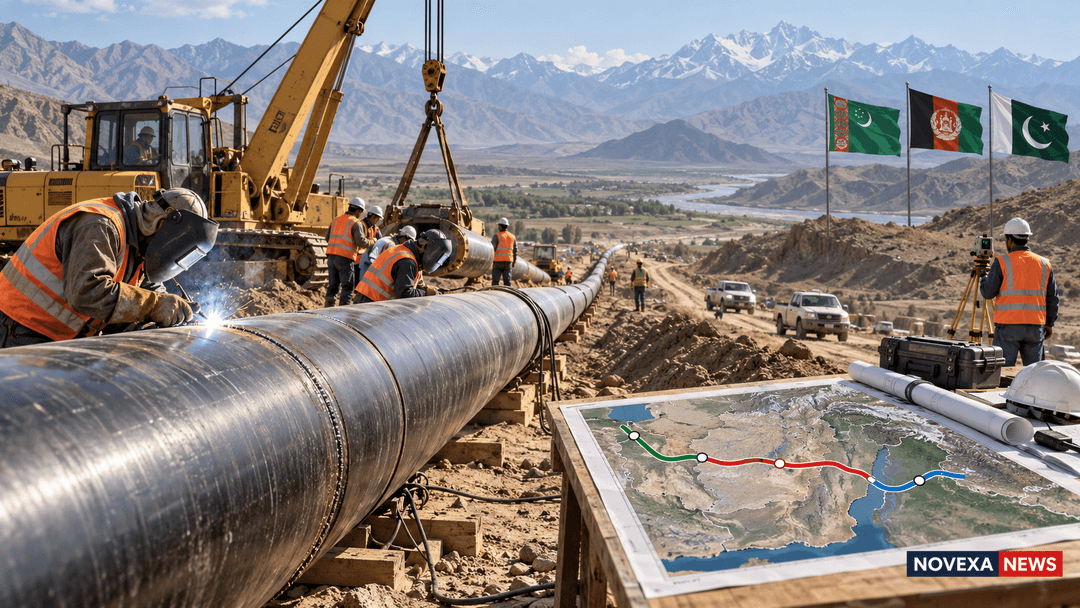
Image credit: AI-generated editorial illustration by Novexa News
The Strait of Hormuz crisis has moved beyond a narrow regional-security story. It is now an economic warning for countries that depend on imported fuel, and Pakistan sits directly in that exposed group.
The strait is one of the world's most important energy chokepoints. The International Energy Agency says about 20 million barrels per day of crude oil and oil products moved through the route in 2025, equal to around a quarter of global seaborne oil trade. The same corridor is also central to liquefied natural gas flows, especially from Qatar and the UAE.
Why Hormuz matters
The Strait of Hormuz links the Persian Gulf with the Gulf of Oman and the Arabian Sea. Its geography makes it hard to replace. Saudi Arabia and the UAE have some alternative oil export routes, but the IEA notes that bypass capacity is limited compared with the volume that normally passes through the strait.
That is why even a partial disruption can be felt far from the Gulf. Oil is globally priced, so a shock in one corridor quickly affects import bills, shipping costs, insurance premiums and inflation expectations in countries that may not be directly involved in the conflict.
Pakistan's exposure
Pakistan is especially vulnerable because its economy depends heavily on imported petroleum and imported LNG. The Pakistan Institute of Development Economics has warned that a Hormuz shock would not only raise petroleum prices but also increase freight rates, lengthen shipments and add war-risk insurance premiums.
That means the problem is wider than the price of crude oil on a screen. The landed cost of fuel can rise through several channels at once: global benchmarks, shipping delays, tanker availability, insurance charges and currency pressure.
For Pakistan, each of those channels can feed into inflation. Transport becomes more expensive, electricity generation costs can rise, and businesses face higher operating costs. In a country already sensitive to fuel-price movements, even a sustained moderate increase can become politically and economically difficult.
The LNG concern
The LNG dimension may be just as important as crude oil. The IEA says LNG exports from Qatar and the UAE are highly dependent on the Strait of Hormuz, and that Qatar and UAE shipments through the route represented almost one-fifth of global LNG trade in 2025.
Pakistan's power and industrial systems are exposed to gas-supply pressure. If LNG cargoes become more expensive or harder to schedule, electricity planning becomes more complicated and gas-intensive industries can face production stress.
This is why a Hormuz disruption can become a domestic energy-security issue for Pakistan very quickly. It can affect power-sector costs, industrial output, fertilizer production, transport prices and household budgets at the same time.
Global inflation risk
The wider world faces a similar chain reaction. Higher fuel costs can push up the cost of food, shipping, aviation, manufacturing and electricity. Developing economies usually have less room to absorb those shocks because fiscal space is limited and consumers are more sensitive to changes in basic prices.
Asian economies are particularly exposed because a large share of oil and LNG moving through Hormuz is destined for Asian markets. The IEA notes that the bulk of crude leaving the strait goes to countries including China, India and Japan, while Pakistan, Bangladesh and India are vulnerable to LNG disruption from the same corridor.
If the shock lasts, governments face difficult choices: absorb costs through subsidies, pass prices on to consumers, tighten demand, or seek emergency supplies from alternative markets. None of those options is painless.
Diplomacy and economic caution
Pakistan's foreign-policy position is complicated by its relationships across the region. Islamabad maintains ties with Saudi Arabia, the UAE, Iran, China and the United States, so escalation in the Gulf creates diplomatic as well as economic pressure.
The practical interest for Pakistan is clear: avoid a wider conflict, keep maritime routes open and prevent an energy-price shock from turning into a balance-of-payments problem. Diplomatic engagement may not control events by itself, but silence would leave Pakistan reacting to decisions made elsewhere.
The crisis also shows why energy planning cannot be separated from foreign policy. A disruption in a shipping lane can quickly become a domestic issue through fuel stations, electricity bills and industrial supply chains.
Lessons for Pakistan
The long-term lesson is diversification. Pakistan needs broader fuel sourcing, stronger strategic reserves, more local refining capacity, faster renewable-energy deployment and better demand management. These steps cannot remove global risk, but they can reduce the speed and severity with which shocks hit households and businesses.
The country also needs clearer contingency planning for LNG and petroleum imports. Alternative suppliers and routes can help, but they usually come at a price. Building resilience before a crisis is cheaper than scrambling during one.
The Strait of Hormuz crisis should therefore be read as more than an oil-market headline. It is a reminder that Pakistan's economic stability depends partly on maritime security far beyond its coastline. The immediate priority is to protect supply and contain inflationary pressure; the long-term priority is to reduce the country's exposure before the next geopolitical shock arrives.
Source links
Comments
No approved comments yet.